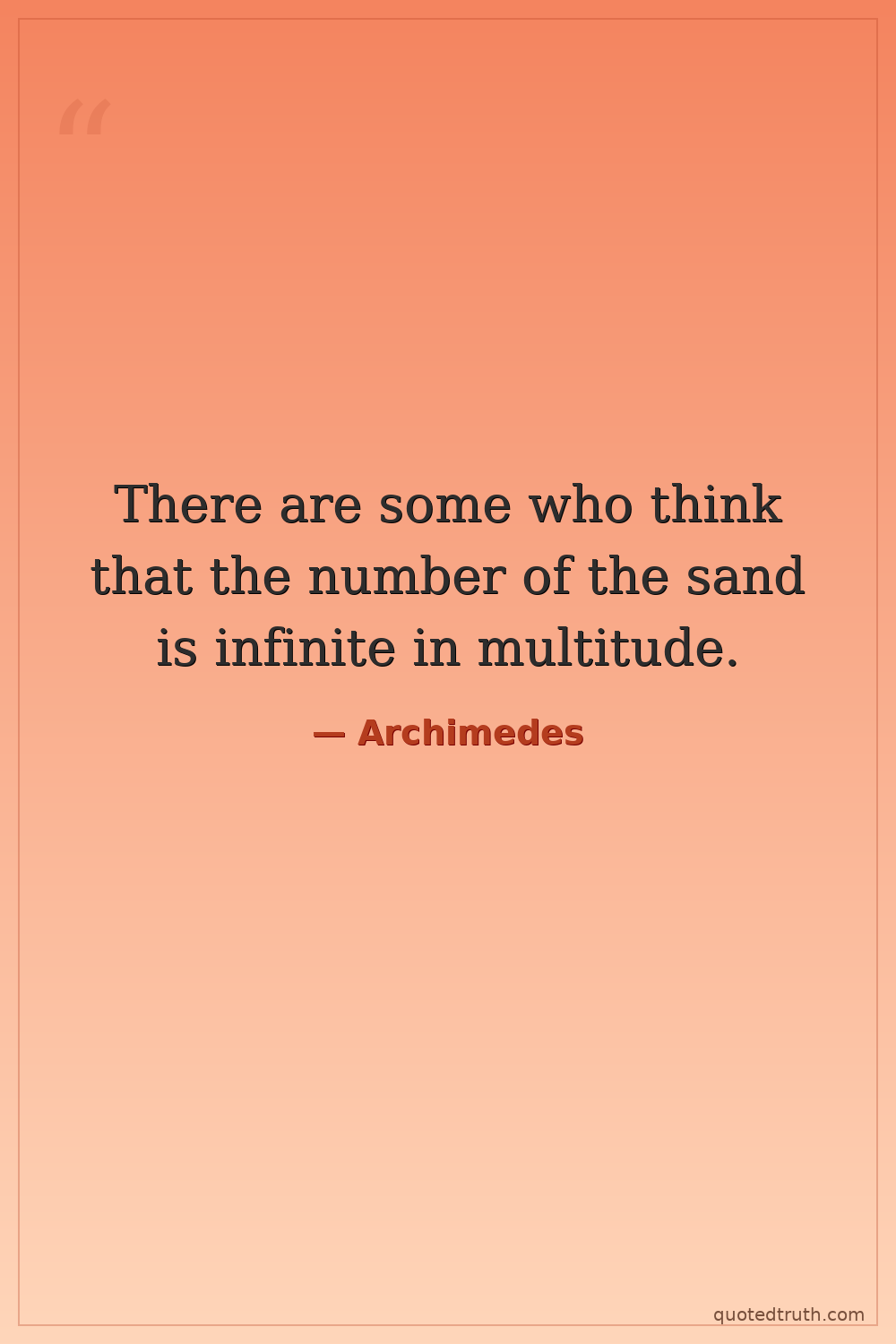
Archimedes — "There are some who think that the number of the sand is infinite in multitude."
There are some who think that the number of the sand is infinite in multitude.
There are some who think that the number of the sand is infinite in multitude.
Click any product to generate a realistic preview. Up to 3 at a time.
* Initial load can take up to 90 seconds — revising the preview in another color is nearly instant.
"Eureka! (I have found it!)"
"It is not possible to find a number greater than the number of grains of sand which could be contained in a sphere of the size of the universe."
"Any solid lighter than a fluid will, if placed in the fluid, be immersed in it to such an extent that the weight of the solid will be equal to the weight of the fluid displaced."
"There are things which seem incredible to most men who have not studied mathematics."
"The spiral, by a continuous motion, generates an infinite number of lines."
From 'The Sand Reckoner', challenging the concept of infinite numbers.
Date: c. 250 BCE
GeneralFound in 1 providers: grok
1 source checked
Some people assume that vast quantities — like grains of sand — are simply too large to count, effectively infinite. This quote challenges that lazy assumption. Archimedes is setting up a bold claim: that no quantity, however enormous, is truly beyond enumeration. Enormity and infinity are not the same thing, and he intends to prove it by actually calculating a number large enough to count every grain of sand in the known universe.
This line opens Archimedes's treatise 'The Sand Reckoner,' written to King Gelon II of Syracuse. Archimedes spent his life reducing the apparently impossible to the computable — calculating pi, deriving volumes of spheres, modeling levers and pulleys. Dismissing a problem as infinite was, to him, intellectual surrender. His response was to invent a numerical system capable of expressing 10 to the 63rd power, anticipating scientific notation by two millennia. The quote perfectly captures his refusal to accept 'too big to measure.'
In third-century BC Greece, Aristotle's philosophy dominated: he distinguished 'potential' from 'actual' infinity, and most thinkers accepted that certain quantities were simply beyond number. Greek numeral systems had no notation for astronomically large values. Archimedes lived in Syracuse during the height of Hellenistic science, a moment when mathematics was advancing but still lacked formal tools for the very large. His Sand Reckoner directly confronted this cultural and philosophical ceiling, pushing Greek mathematics into territory it had never formally entered.
AI-generated insights based on extensive research and information for context. Factual errors? Email [email protected].
Your cart is empty