What it means
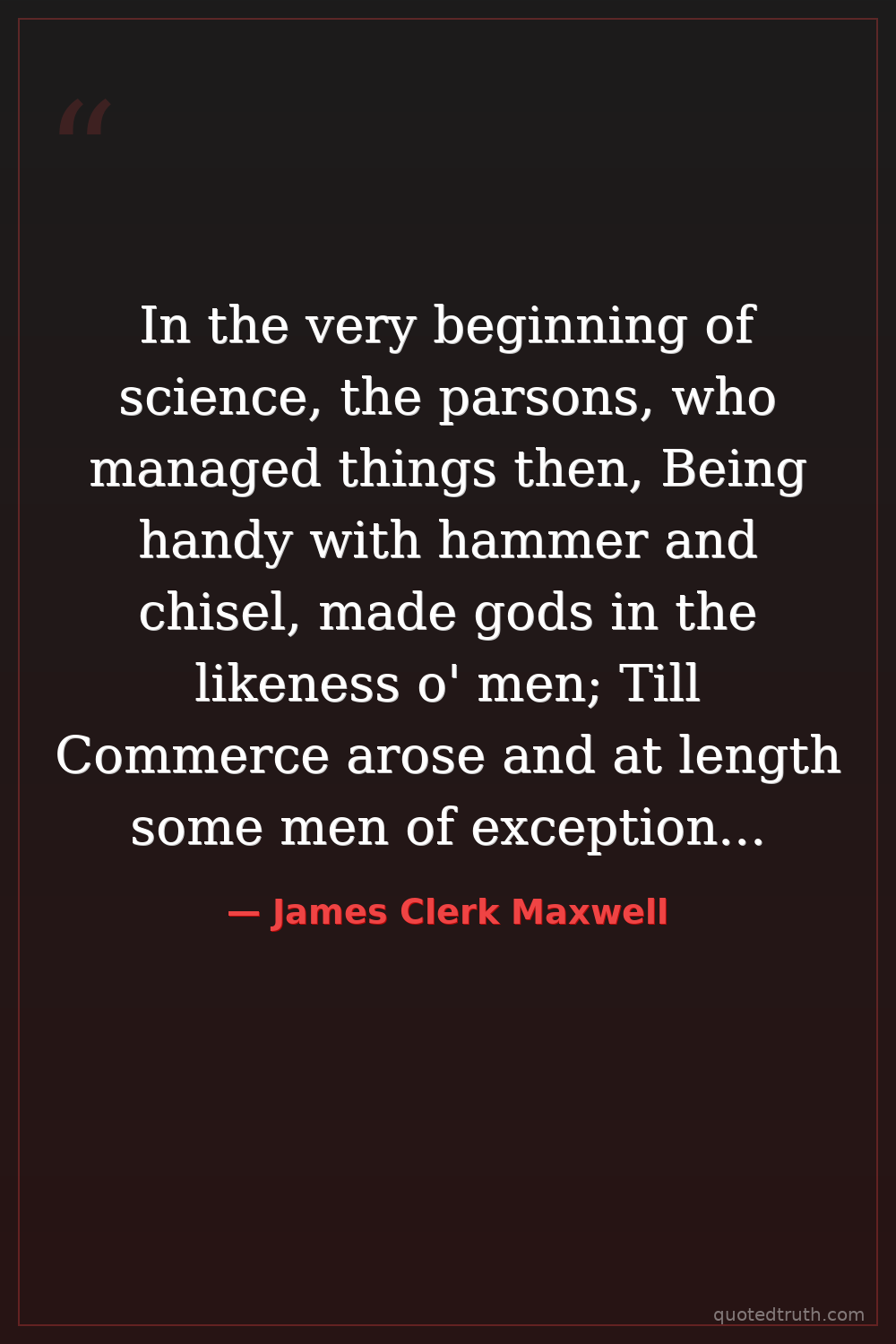
This verse traces how humans have explained the world across history. First, priests carved gods in human form to account for nature. Later, as trade and inquiry advanced, remarkable thinkers replaced those gods and spirits with atoms as the fundamental building blocks of reality. The quote sketches a progression from myth to commerce to science, arguing that atomic theory has displaced supernatural explanations and now stands as the enduring account of what the universe is made of.
Relevance to James Clerk Maxwell
Maxwell unified electricity, magnetism, and light into four equations and helped pioneer statistical mechanics, work that depended on the atomic hypothesis. A devout Presbyterian with a sharp wit, he wrote light verse poking at science and religion alike. His kinetic theory of gases treated matter as swarms of atoms, so celebrating atoms as the victor over demons and idols matches both his physics and his playful, historically literate voice.
The era
Maxwell wrote in Victorian Britain, where industrial commerce funded laboratories and Darwin, Tyndall, and Huxley were publicly contesting clerical authority over nature. Atomic theory was gaining ground through Dalton, Avogadro, and kinetic gas work, though atoms remained contested until the early 1900s. Geology and biology were dismantling literal Genesis timelines, and debates about materialism versus design filled the periodicals. Maxwell's lines capture that moment when science, backed by industrial wealth, was openly replacing theological cosmology.
AI-generated insights based on extensive research and information for context. Factual errors? Email [email protected].