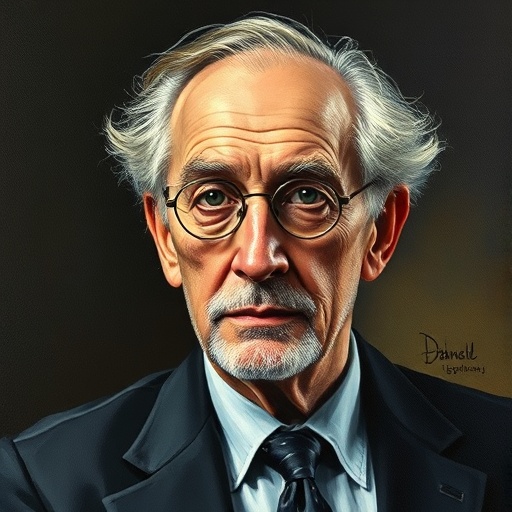
Francis Crick — "It is important to be open to new ideas, but not so open that your brains fall o…"
It is important to be open to new ideas, but not so open that your brains fall out.
It is important to be open to new ideas, but not so open that your brains fall out.
Click any product to generate a realistic preview. Up to 3 at a time.
* Initial load can take up to 90 seconds — revising the preview in another color is nearly instant.
"I would not trust any experiment in biology unless it was confirmed by a physicist."
"The ultimate aim of the modern movement in biology is in fact to explain all biology in terms of physics and chemistry."
"I am an atheist, and I don't believe in God."
"I enjoy being controversial."
"There is no ghost in the machine."
Found in 1 providers: grok
1 source checked
Balance intellectual curiosity with critical judgment. Welcoming new ideas is essential to progress, but accepting them uncritically is its own failure. A rigorous thinker evaluates novelty against evidence and logic rather than embracing it merely because it is unconventional. Open-mindedness without skepticism collapses into credulity — making a person vulnerable to pseudoscience, wishful thinking, and fashionable nonsense dressed up as insight.
Crick embodied disciplined boldness his entire career — abandoning physics for biology, rejecting vitalism, and insisting life could be explained materially. The DNA structure required not speculation but Rosalind Franklin's X-ray diffraction data before Crick accepted the double helix model. Later pursuing consciousness research, he again demanded mechanistic evidence. He was genuinely radical yet ferociously skeptical, a combination that made him effective rather than merely provocative.
The mid-20th century was simultaneously an age of legitimate scientific revolution and a boom in fringe thinking — Lysenkoism corrupted Soviet biology, parapsychology sought academic respectability, and Cold War anxieties fueled pseudoscientific movements. Molecular biology itself was so new that distinguishing visionary ideas from nonsense was genuinely hard. Scientists faced pressure to be both daring and rigorous, making Crick's formulation of that tension unusually pointed and practical.
AI-generated insights based on extensive research and information for context. Factual errors? Email [email protected].
Your cart is empty