What it means
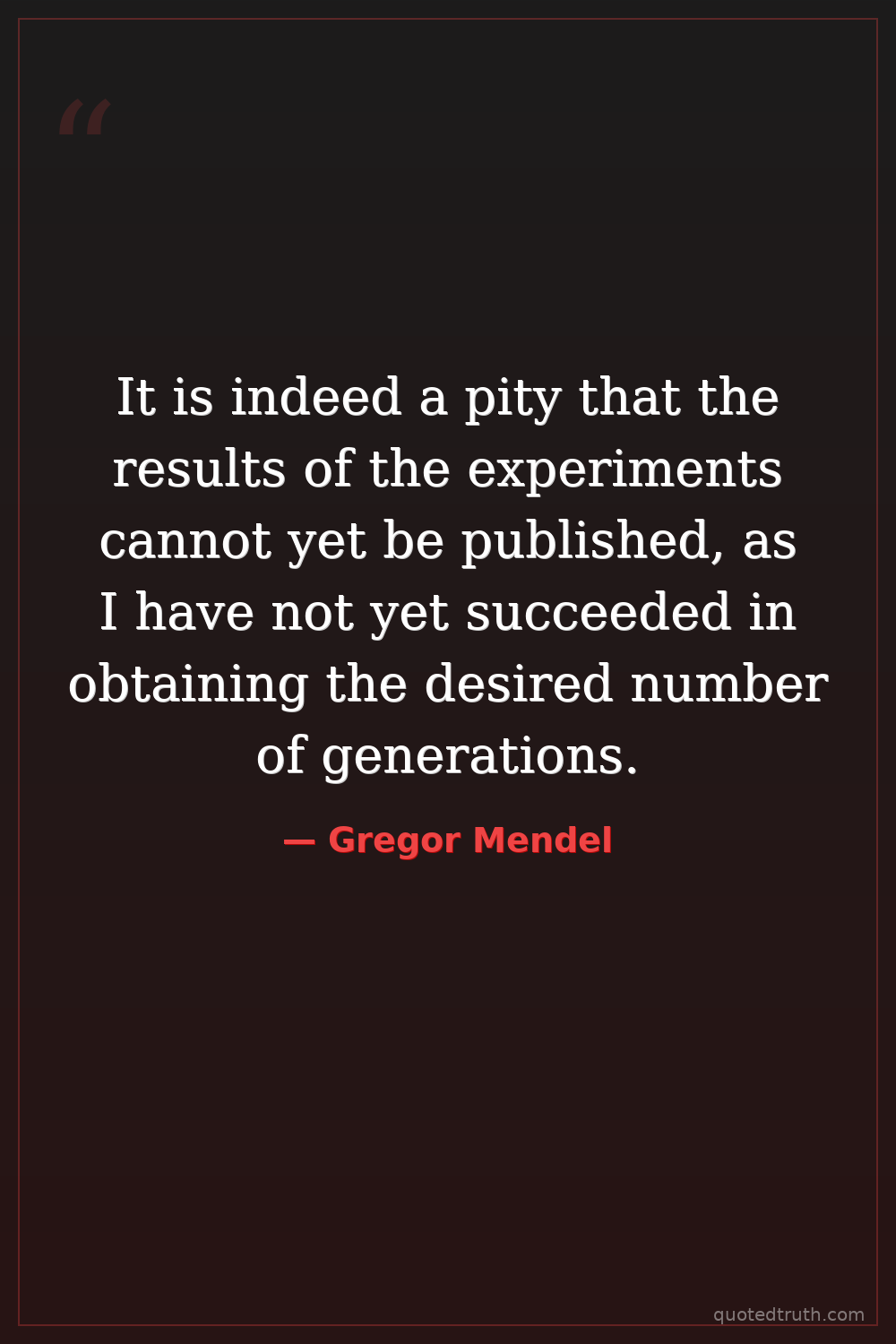
The speaker regrets being unable to share experimental results because not enough generational data has been collected yet. Science demands sufficient evidence before publishing — rushing conclusions undermines credibility. The frustration is real: the insights exist internally, but the proof isn't complete. Patience isn't optional; it's the price of being taken seriously. Incomplete data sets, however promising, cannot responsibly be presented as established findings.
Relevance to Gregor Mendel
Mendel spent roughly eight years cultivating and tracking thousands of pea plants across generations in the Augustinian monastery garden in Brno. His entire methodology rested on statistical rigor across multiple breeding cycles — shortcuts would have invalidated everything. This quote captures his defining trait: scientific discipline overriding personal ambition. Tragically, even his completed 1866 paper went unrecognized for decades, making his patient restraint all the more bittersweet in hindsight.
The era
In 1860s Austro-Hungarian Empire, science lacked modern peer-review infrastructure or rapid publication channels. Darwin's On the Origin of Species (1859) had just ignited urgent questions about heredity and variation, yet no mechanism existed to explain how traits passed between generations. Mendel worked in near-isolation without institutional research funding. Long multi-year experiments were common precisely because there was no competitive race to publish — but that also meant vital discoveries could be buried for a generation.
AI-generated insights based on extensive research and information for context. Factual errors? Email [email protected].