What it means
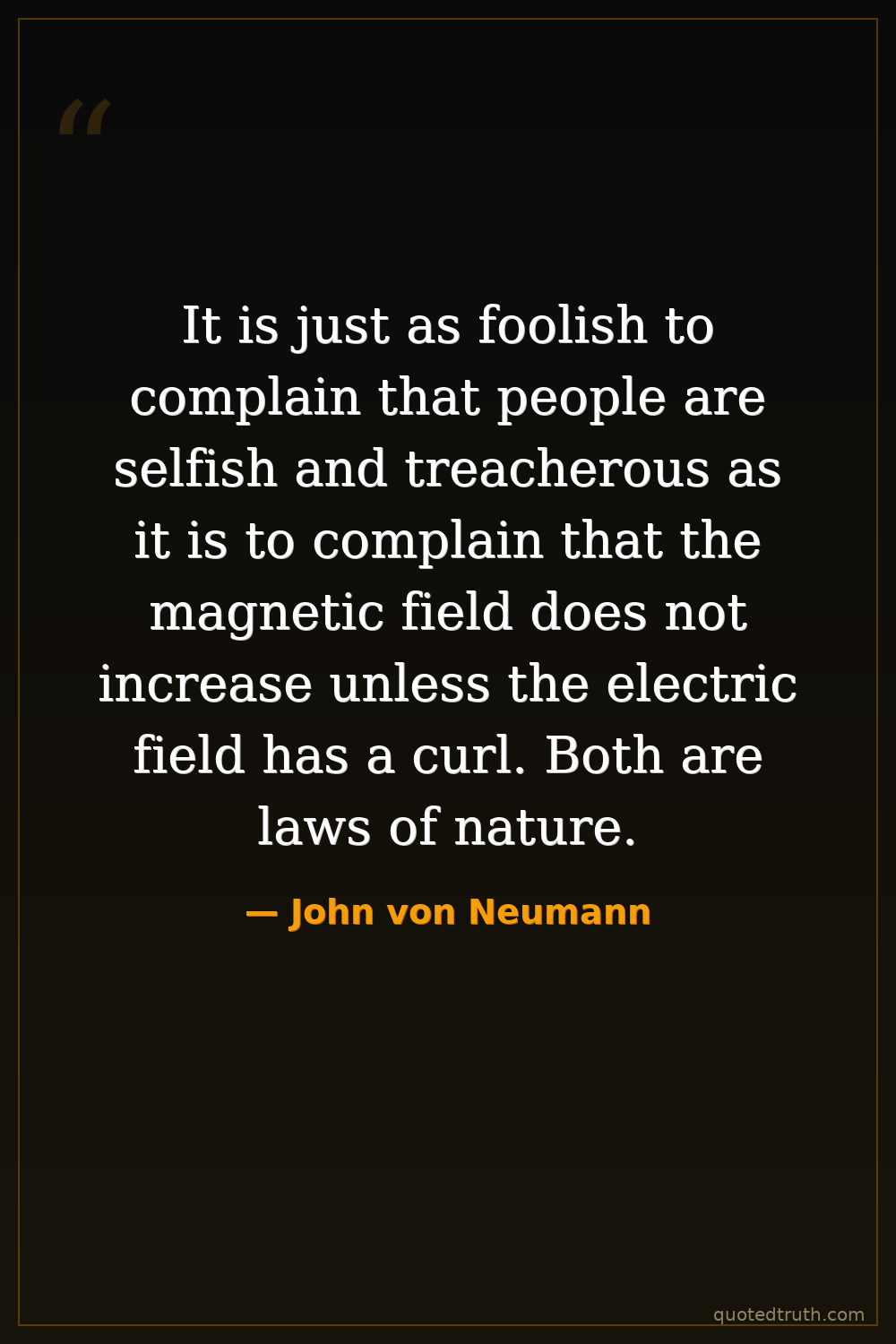
Complaining that people act selfishly or betray one another is as pointless as complaining that physics works the way it does. Human self-interest and deception are not moral failures to be lamented — they are predictable features of human nature, as reliable and immutable as electromagnetic laws. Rational people should account for these tendencies the way engineers account for physical constraints: not with outrage, but with clear-eyed understanding and design around them.
Relevance to John von Neumann
Von Neumann co-invented game theory, which mathematically models strategic behavior among rational, self-interested actors — exactly the human nature this quote describes. He worked on the Manhattan Project and advised on Cold War nuclear strategy, environments where anticipating treachery was survival. His worldview treated social phenomena as rigorously as physics, and he was widely known for cold, unsentimental realism about human motivation rather than idealistic moralizing.
The era
Von Neumann lived through WWII and the early Cold War, when betrayal and espionage were daily realities — Soviet spies, shifting alliances, nuclear brinkmanship. Maxwell's equations were already foundational to physics, making the analogy instantly recognizable to contemporaries. Game theory emerged in this same period precisely to model adversarial behavior mathematically rather than morally. The quote captures a moment when naive trust between nations had collapsed and strategic calculation replaced idealism.
AI-generated insights based on extensive research and information for context. Factual errors? Email [email protected].