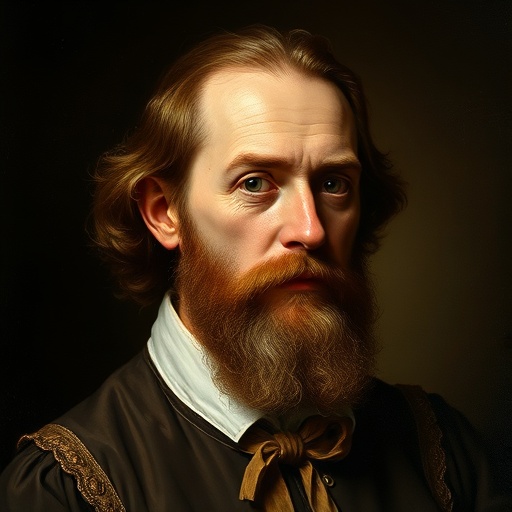
William Harvey — "It seems to me that the motion of the blood is like that of water in a mill-stre…"
It seems to me that the motion of the blood is like that of water in a mill-stream.
It seems to me that the motion of the blood is like that of water in a mill-stream.
Click any product to generate a realistic preview. Up to 3 at a time.
* Initial load can take up to 90 seconds — revising the preview in another color is nearly instant.
"I have often wondered and even laughed at those who fancied that everything had been so consummately and absolutely investigated by an Aristotle or a Galen or some other mighty name, that nothing coul…"
"I am not so mad, nor have I been so caught up in the opinion of others, as to believe that I have discovered anything so great as to be worthy of the name of a new opinion."
"The examination of the bodies of animals has always been my delight."
"The animal body is a commonwealth, in which every member is a subject to the whole."
"The true physician is one who loves humanity."
English physician whose On the Motion of the Heart and Blood in Animals (1628) demonstrated blood circulation, overturning 1,400 years of Galenic medicine. Closely associated with Francis Bacon (his contemporary in the new English empiricism). For an intellectual contrast, see Galenic medicine, the 2nd-century Greek medical tradition (humors, blood-as-consumed-fuel) — Harvey calculated that the heart pumps more blood per hour than the body could possibly produce as fuel — a single quantitative observation that demolished the entire Galenic-Aristotelian medical worldview. The cleanest example in medical history of arithmetic disproving 14 centuries of authority.
Found in 1 providers: grok
1 source checked
Blood moves through the body in a continuous loop, like water flowing endlessly through a mill-stream — always in motion, always circulating back to its source. Harvey is rejecting the old idea that blood is constantly manufactured and consumed, and instead describing a closed circuit driven by the heart, where the same blood recirculates rather than being depleted and replaced.
Harvey published 'De Motu Cordis' in 1628, overturning 1,400 years of Galenic medicine that held blood was produced in the liver and burned up by organs. Trained in Padua under Fabricius and later royal physician to James I and Charles I, Harvey grounded his work in dissection and quantitative reasoning. The mill-stream metaphor reflects his empirical, mechanistic mind — reaching for a familiar industrial image to make a radical physiological truth concrete.
The early 17th century sat at the heart of the Scientific Revolution, when thinkers increasingly modeled nature as machinery. Galileo was mathematizing motion; Descartes would soon declare the body a machine. Harvey's analogy participates in that mechanistic turn, arriving precisely as Galenic humoral theory — unchallenged since the 2nd century — crumbled under direct observation. Watermills were the era's most visible continuous-motion machines, making the comparison immediately legible to any educated contemporary.
AI-generated insights based on extensive research and information for context. Factual errors? Email [email protected].
Your cart is empty