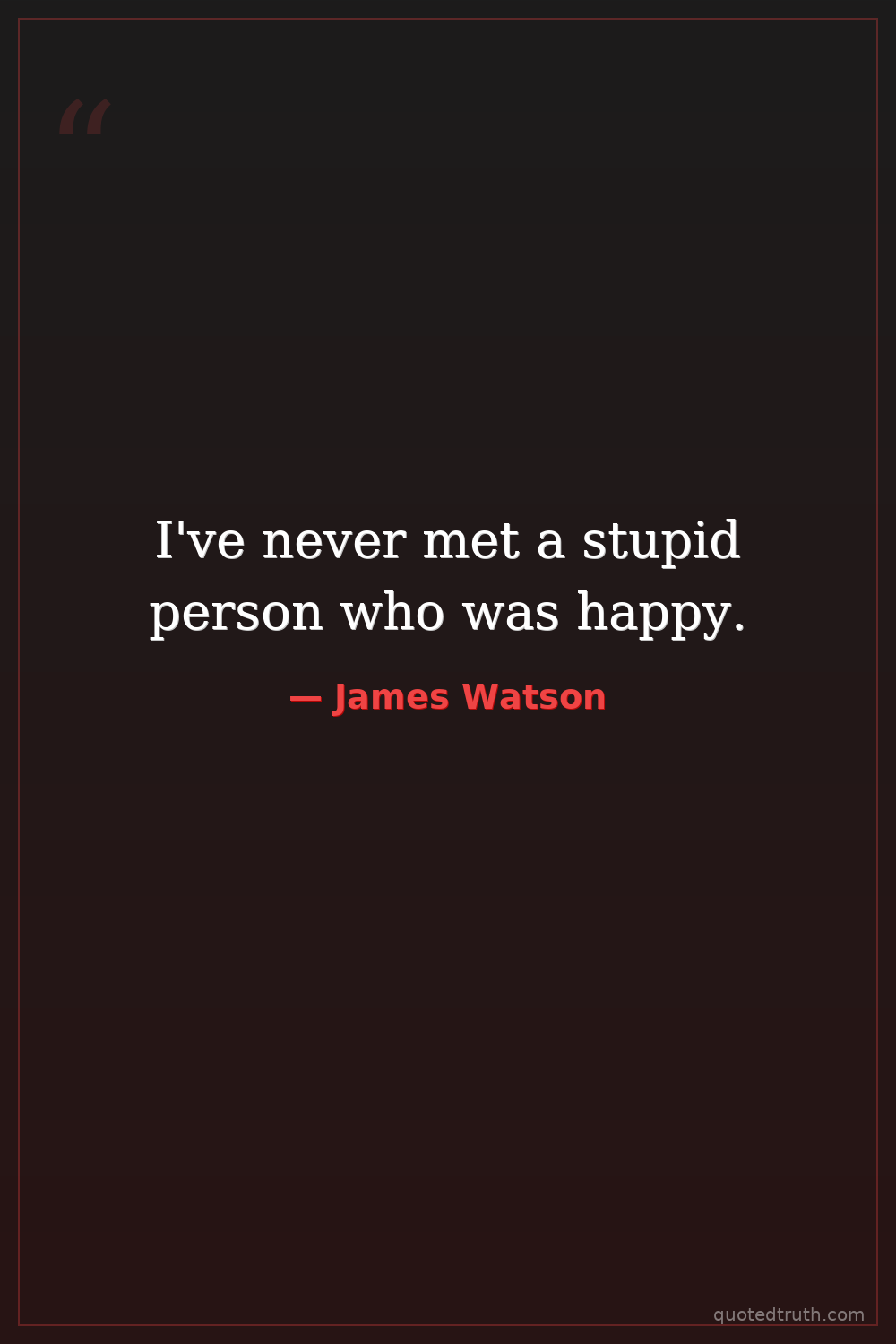
James Watson — "I've never met a stupid person who was happy."
I've never met a stupid person who was happy.
I've never met a stupid person who was happy.
Click any product to generate a realistic preview. Up to 3 at a time.
* Initial load can take up to 90 seconds — revising the preview in another color is nearly instant.
"I was never good at math."
"If you could find the gene which determines sexuality and a woman decides she doesn't want a homosexual child, well, let her."
"The greatest joy is to discover something new."
"It's much more fun to be famous than not to be famous."
"I’m an optimist. I think we can make better human beings."
Found in 1 providers: grok
1 source checked
The quote claims genuine happiness requires intellectual engagement — a sharp, active mind is a precondition for contentment. Watson argues that dullness of thought leaves people unable to fully understand their circumstances, find meaning, or solve the problems causing suffering. True happiness demands curiosity, comprehension, and mental clarity. Stupidity — meaning intellectual stagnation or incuriosity — prevents the self-awareness and engagement needed to build a genuinely satisfying life.
Watson's career was defined by fierce intellectual competition — the race to crack DNA's structure demanded relentless reasoning and confidence in one's mind. He co-won the 1962 Nobel Prize and led Cold Spring Harbor Laboratory for decades. Watson never shied from controversial views on intelligence, making provocative public statements linking intellect to outcomes. This quote epitomizes his core worldview: sharp minds aren't just useful, they are essential to human achievement and genuine wellbeing.
Watson's career spans the post-WWII scientific boom through the genomics revolution of the 2000s. His era saw intensifying debates over IQ heritability, meritocracy, and what biology could say about cognition. The DNA discovery itself suggested human potential was encoded and unlockable through understanding. Watson's controversial 2007 statements about intelligence and race, and his 2019 stripping of honorary titles, reflected broader cultural battles over science, intellect, and who gets to define human capability.
AI-generated insights based on extensive research and information for context. Factual errors? Email [email protected].
Your cart is empty