Michael Faraday — "Lectures which really teach will never be popular; lectures which are popular wi…"
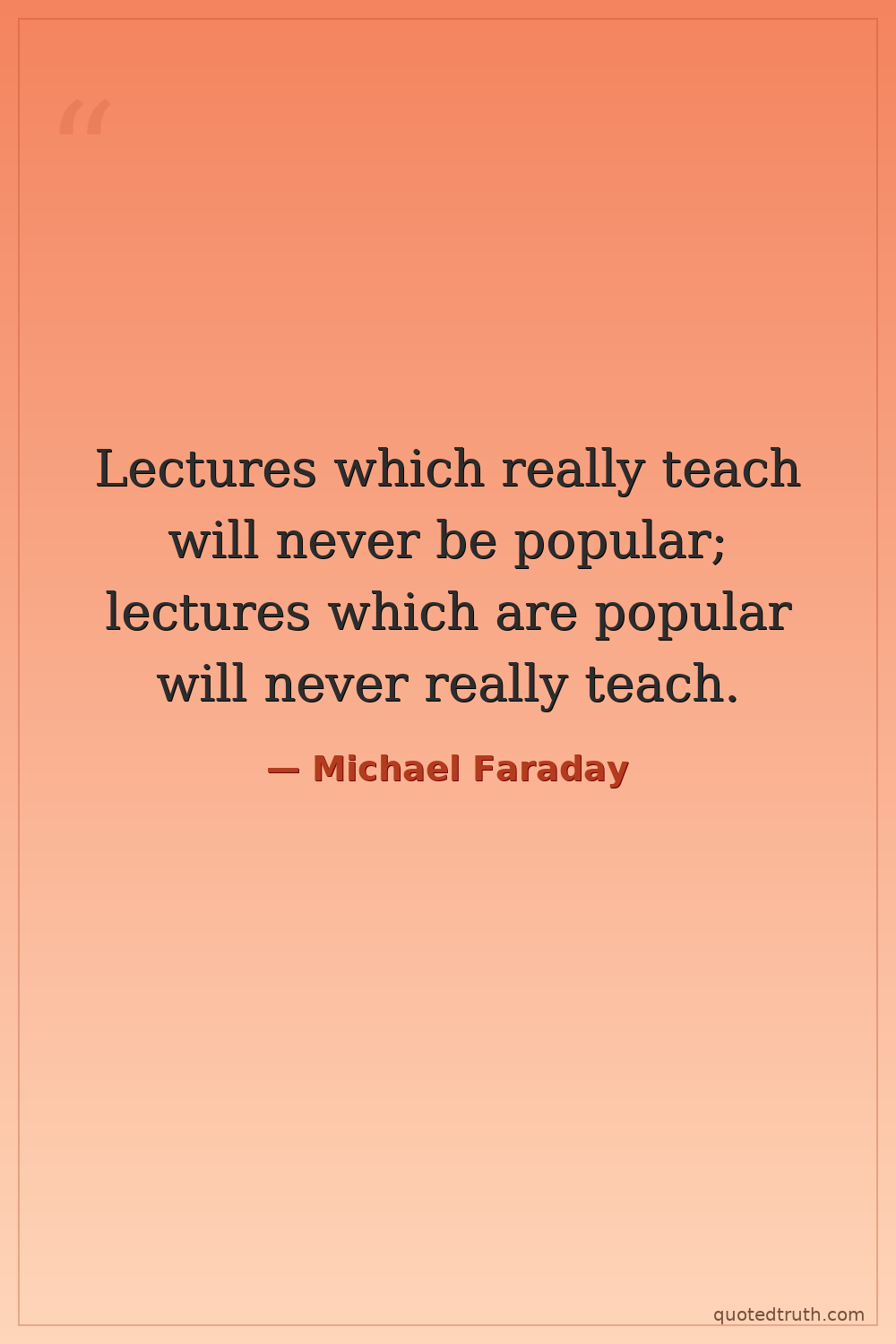
Lectures which really teach will never be popular; lectures which are popular will never really teach.
Lectures which really teach will never be popular; lectures which are popular will never really teach.
Click any product to generate a realistic preview. Up to 3 at a time.
* Initial load can take up to 90 seconds — revising the preview in another color is nearly instant.
"The lecturer should endeavor to rouse the minds of his auditors, and to fix their attention."
"I have no other guide than the truth, and I will follow it wherever it leads."
"I could trust a fact and always cross-examine an assertion."
"I am a very happy man, and have a good wife, and am very well content."
"The pursuit of knowledge is a noble endeavor, and it is one that brings great rewards."
A somewhat cynical but witty observation on education and popularity.
Date: 19th century (approximate)
GeneralFound in 1 providers: gemini
1 source checked
Real teaching demands effort, challenges assumptions, and forces listeners to grapple with difficult ideas, which most audiences find uncomfortable. Entertaining lectures that draw crowds succeed by simplifying, flattering, and amusing rather than stretching minds. The two goals pull in opposite directions: genuine instruction changes how you think and therefore feels hard, while popularity rewards ease and spectacle. You cannot optimize for both at once without sacrificing one.
Faraday delivered the Royal Institution's Friday Evening Discourses and founded the Christmas Lectures for young people, so he spoke from decades of platform experience. Largely self-taught from a bookbinder's apprenticeship, he valued rigor over showmanship yet was famous for clear demonstrations. His warning reflects tension he personally navigated: drawing fashionable London audiences to science while refusing to dilute the electromagnetic and chemical findings that built modern physics.
Victorian Britain turned science into public entertainment, with gas-lit lecture halls, traveling demonstrators, and magic-lantern shows competing for paying crowds. The Royal Institution itself sold tickets to wealthy patrons eager to witness sparks, explosions, and electrical marvels. Industrial progress made science fashionable, but also pressured lecturers toward spectacle. Faraday worked at the center of this boom during the 1820s through 1850s, watching colleagues trade depth for applause as mass literacy and popular magazines expanded science's audience.
AI-generated insights based on extensive research and information for context. Factual errors? Email [email protected].
Your cart is empty