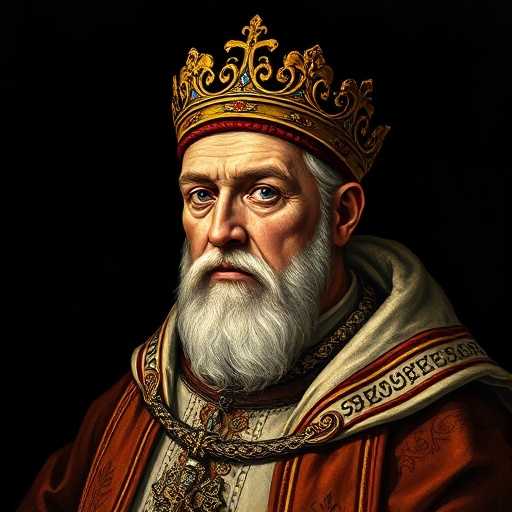
Pope Urban II — "We grant to all who undertake this expedition a plenary indulgence."
We grant to all who undertake this expedition a plenary indulgence.
We grant to all who undertake this expedition a plenary indulgence.
Click any product to generate a realistic preview. Up to 3 at a time.
* Initial load can take up to 90 seconds — revising the preview in another color is nearly instant.
"When they wish to torture people by a base death, they perforate their navels, and dragging forth the extremity of the intestines, bind it to a stake; then with flogging they lead the victim around un…"
"Take the road to the Holy Sepulchre and wrench the land from that wicked race."
"Oh, how admirable is that salting! Truly, you must strive by the salt of wisdom to correct these foolish people, hastening open-mouthed after the pleasures of this world, lest putrefied by sins and un…"
"Let those who have been exhausting themselves to the detriment both of body and soul now strive for a twofold reward."
"It is Jesus Christ Himself who leaves His Sepulcher and presents to you His Cross. It will be the sign that will unite the dispersed children of Israel. Raise it to your shoulders and place it on your…"
Pope (1088-1099) whose Council of Clermont speech (November 1095) launched the First Crusade — the founding event of nine centuries of Christian-Muslim military conflict. Closely associated with Pope Gregory VII (his predecessor on papal-imperial reform). For an intellectual contrast, see Saladin, Kurdish-Muslim Sultan of Egypt and Syria (1138-1193) — Saladin recaptured Jerusalem in 1187, undoing the First Crusade Urban II launched 92 years earlier. Saladin's chivalrous treatment of Christian prisoners became the canonical Muslim counter-image to Crusader brutality. The cleanest before/after pairing of the Crusades' moral arc.
Found in 1 providers: grok
1 source checked
The Church promises complete forgiveness of all sins — a plenary indulgence — to anyone joining this military expedition. In modern terms: participants receive a spiritual clean slate, eternal punishment for every past sin fully erased. This reframed warfare as a path to guaranteed salvation, collapsing the distinction between soldier and saint. Dying in the campaign wasn't tragedy — it was the ultimate religious credential, a direct pass into heaven.
Urban II was a Cluniac monk before becoming pope — deeply formed by rigorous penance and spiritual merit. His authority to grant indulgences was the Church's most potent spiritual currency. At the Council of Clermont in 1095, this promise was his central recruitment lever, packaging military conquest as supreme piety. His reformist instincts saw crusading as simultaneously purifying Christendom and redirecting knightly violence toward a sanctioned, spiritually rewarded purpose.
By 1095, Seljuk Turks controlled Jerusalem and had crushed Byzantine forces at Manzikert in 1071. Emperor Alexios I desperately sought Western military aid. Meanwhile, Europe's feudal warrior class lived in endemic violence the Church struggled to contain through Peace of God decrees. Eternal damnation was viscerally real to medieval Christians — not metaphor. Offering total absolution transformed an impossible theological burden into a solvable equation: join the campaign, die cleansed, enter paradise.
AI-generated insights based on extensive research and information for context. Factual errors? Email [email protected].
Your cart is empty