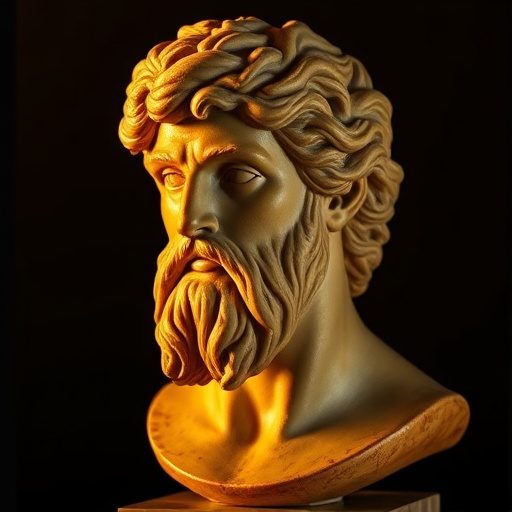
Pythagoras — "Let no one persuade you by word or deed to do or say whatever is not best for yo…"
Let no one persuade you by word or deed to do or say whatever is not best for you.
Let no one persuade you by word or deed to do or say whatever is not best for you.
Click any product to generate a realistic preview. Up to 3 at a time.
* Initial load can take up to 90 seconds — revising the preview in another color is nearly instant.
"Don't offer your right hand too easily."
"Declining from the public ways, walk in unfrequented paths."
"Abstain from animals."
"The square of the hypotenuse of a right-angled triangle is equal to the sum of the squares of the other two sides."
"Don't piss towards the sun."
Greek philosopher and mathematician whose school in Croton combined geometry (the Pythagorean theorem), number-mysticism, and a religious-vegetarian way of life. Closely associated with Thales of Miletus (earlier pre-Socratic and the first philosopher). For an intellectual contrast, see Heraclitus, pre-Socratic Greek philosopher of flux — Heraclitus called Pythagoras 'the chief of swindlers' — among the founding insults of the philosophical-rivalry tradition. Their 'all is flux' vs 'all is number' poles still organize the philosophy of mathematics today (Platonist vs anti-realist).
Advice on maintaining personal integrity, found in the 'Golden Verses'.
Date: c. 570-495 BCE
WisdomFound in 1 providers: gemini
1 source checked
Guard your decisions against outside pressure. Whether someone tries to convince you through argument or through their actions and example, don't let them lead you toward choices that harm or diminish you. Your own judgment about what serves your wellbeing should take precedence over social pressure, flattery, or manipulation. It is a call for personal autonomy and the strength to resist being steered away from your own authentic path.
Pythagoras founded a secretive philosophical brotherhood in Croton, southern Italy, with strict moral codes governing speech, diet, and behavior. Members faced pressure from within the community and hostility from outside it — Pythagoras himself was eventually driven from Croton by political opposition. His teachings emphasized self-mastery and disciplined living. This quote mirrors his core conviction that rational self-governance, not crowd opinion or persuasion by others, should determine one's actions.
Sixth-century BCE Greece was awash in political rhetoric, sophist argumentation, and civic pressure. City-states like Croton were volatile — demagogues and factions competed for loyalty, and sophists were emerging as professional persuaders who could argue any side for pay. Oral culture meant most influence traveled through spoken word and public example rather than written law. Warning against being swayed by others' words or deeds was a genuinely urgent ethical stance in that environment.
AI-generated insights based on extensive research and information for context. Factual errors? Email [email protected].
Your cart is empty