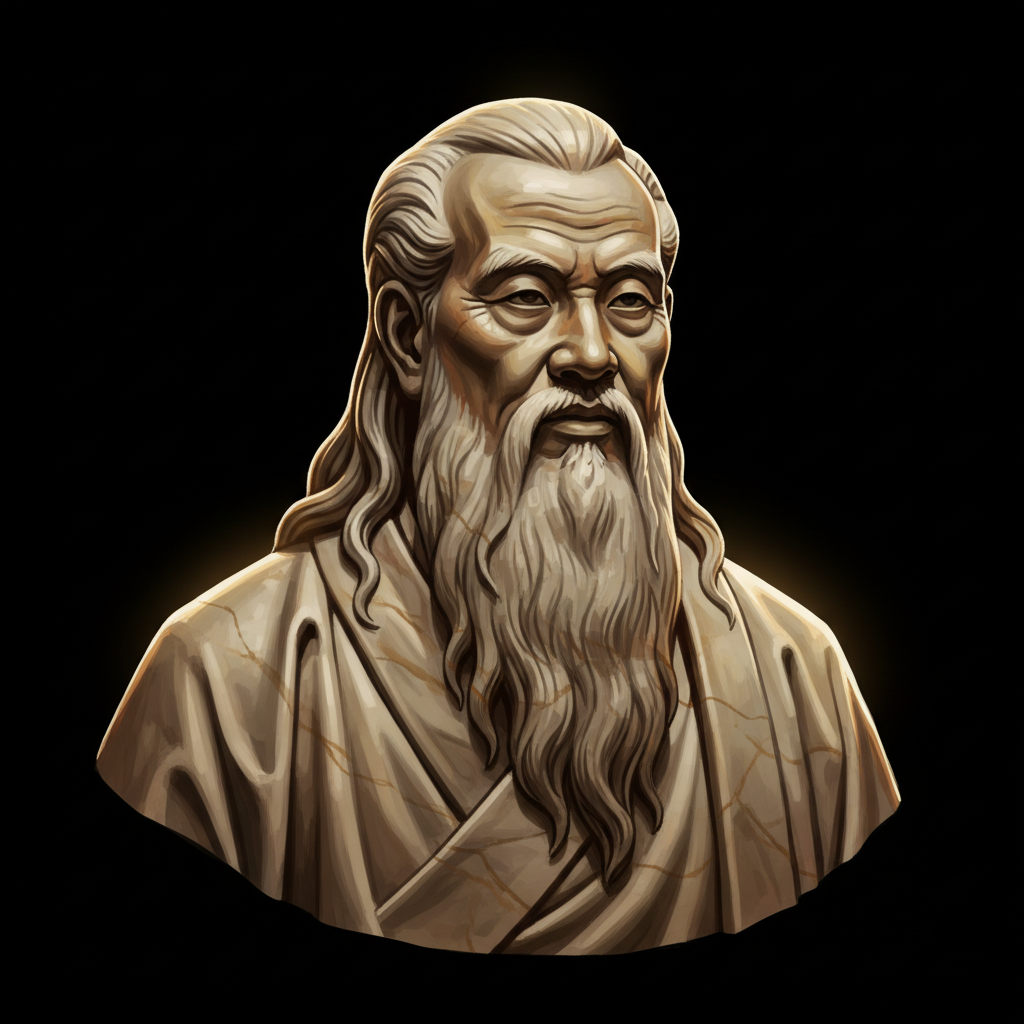
Laozi — "Let people return to making knots on ropes, instead of writing."
Let people return to making knots on ropes, instead of writing.
Let people return to making knots on ropes, instead of writing.
Click any product to generate a realistic preview. Up to 3 at a time.
* Initial load can take up to 90 seconds — revising the preview in another color is nearly instant.
"The greatest paradox of life is that death is the ultimate goal."
"Therefore it is because the sage never attempts to be great that he succeeds in becoming great."
"The five colors blind the eye. The five notes deafen the ear. The five tastes dull the palate. Racing and hunting madden the mind. Precious goods keep their owners in fetters."
"The sage is always without ambition."
"When nothing is done, nothing is left undone."
Reputed founder of Taoism and author of the Tao Te Ching, whose wu wei (effortless action) shaped East Asian philosophy. Closely associated with Zhuangzi (later Taoist who extended Laozi's framework). For an intellectual contrast, see Confucius, near-contemporary Chinese sage of social ritual and duty — Confucius systematized social order through ritual and hierarchy; Laozi argued that all such systems were the disease, not the cure — the two founding poles of Chinese moral philosophy.
Tao Te Ching, Chapter 80, a statement advocating extreme simplicity.
Date: c. 6th-4th century BC
GeneralFound in 1 providers: gemini
1 source checked
Laozi suggests humanity would be better off abandoning complex writing systems and returning to primitive recordkeeping like tying knots in ropes. He argues that sophisticated tools breed cleverness, deception, and bureaucracy. Simpler methods force communities to stay small, intimate, and honest. The advance of literacy, in his view, multiplies cunning rather than wisdom, distancing people from direct experience and natural living.
Laozi championed wu wei (non-action) and a return to primal simplicity, distrusting civilization's accumulated complexity. As keeper of the Zhou royal archives, he witnessed firsthand how written records enabled taxation, law, and political manipulation. Legend says he abandoned that bureaucratic post in disgust, riding west on a buffalo and only writing the Tao Te Ching when a border guard insisted. This quote embodies his lifelong preference for rustic village life over scholarly courts.
Laozi lived during the late Zhou dynasty (6th century BCE), an era of crumbling feudal order leading into the Warring States period. Writing on bamboo strips was expanding rapidly, fueling legalist bureaucracies, complex tax codes, and military logistics. Confucian scholars were elevating literacy and ritual texts as moral foundations. Laozi pushed back against this trend, idealizing earlier neolithic communities where Chinese tradition holds that knotted cords tracked debts, harvests, and agreements before script existed.
AI-generated insights based on extensive research and information for context. Factual errors? Email [email protected].
Your cart is empty