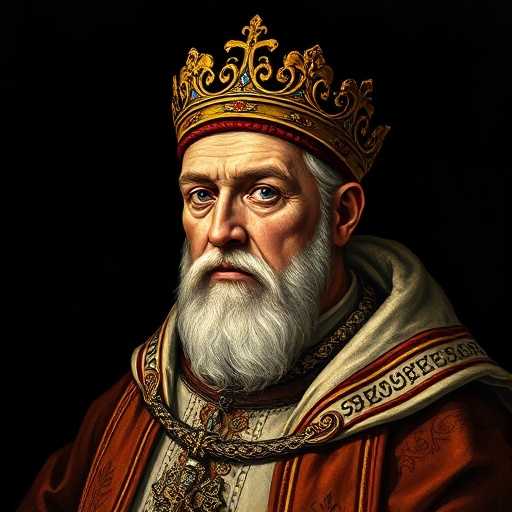
Pope Urban II — "Let those who have been robbers, now become soldiers of Christ."
Let those who have been robbers, now become soldiers of Christ.
Let those who have been robbers, now become soldiers of Christ.
Click any product to generate a realistic preview. Up to 3 at a time.
* Initial load can take up to 90 seconds — revising the preview in another color is nearly instant.
"Let our lives be stronger than death to fight against the enemies of the Christian people."
"It is Christ who commands it."
"Enter upon the road to the Holy Sepulcher; wrest that land from the wicked race, and subject it to yourselves."
"Fight for the Holy Sepulchre, and you will be absolved from all your sins."
"Christ commands it."
Pope (1088-1099) whose Council of Clermont speech (November 1095) launched the First Crusade — the founding event of nine centuries of Christian-Muslim military conflict. Closely associated with Pope Gregory VII (his predecessor on papal-imperial reform). For an intellectual contrast, see Saladin, Kurdish-Muslim Sultan of Egypt and Syria (1138-1193) — Saladin recaptured Jerusalem in 1187, undoing the First Crusade Urban II launched 92 years earlier. Saladin's chivalrous treatment of Christian prisoners became the canonical Muslim counter-image to Crusader brutality. The cleanest before/after pairing of the Crusades' moral arc.
Found in 1 providers: grok
1 source checked
This quote calls for moral redemption through martial service — it invites violent men to redirect their aggression toward a religious cause. Rather than condemning lawlessness, it offers a path to salvation through crusading. The implicit message is that fighting for Christ cleanses past sins; violence becomes virtuous when directed at the right enemy. It reframes destructive behavior as potentially holy, giving warriors a chance to transform guilt into purpose.
Pope Urban II delivered this call at the Council of Clermont in 1095, launching the First Crusade. As a Benedictine monk turned pope, he understood both spiritual discipline and political realism. Feudal Europe's knights terrorized other Christians constantly. Urban shrewdly channeled that martial energy outward toward Jerusalem, simultaneously reducing internal Christian conflict and expanding papal authority — a pragmatic fusion of spiritual mission with geopolitical strategy.
In 1095, Western Europe's feudal nobility was consumed by private warfare, banditry, and inter-Christian violence that the Church condemned through the Peace of God movement. Simultaneously, the Byzantine Empire faced Seljuk Turkish expansion and Jerusalem had fallen to Muslim control. Urban's appeal offered a theological solution to a social crisis: redirect endemic knightly violence toward a holy war, framing Jerusalem's reconquest as divine duty and guaranteed absolution.
AI-generated insights based on extensive research and information for context. Factual errors? Email [email protected].
Your cart is empty