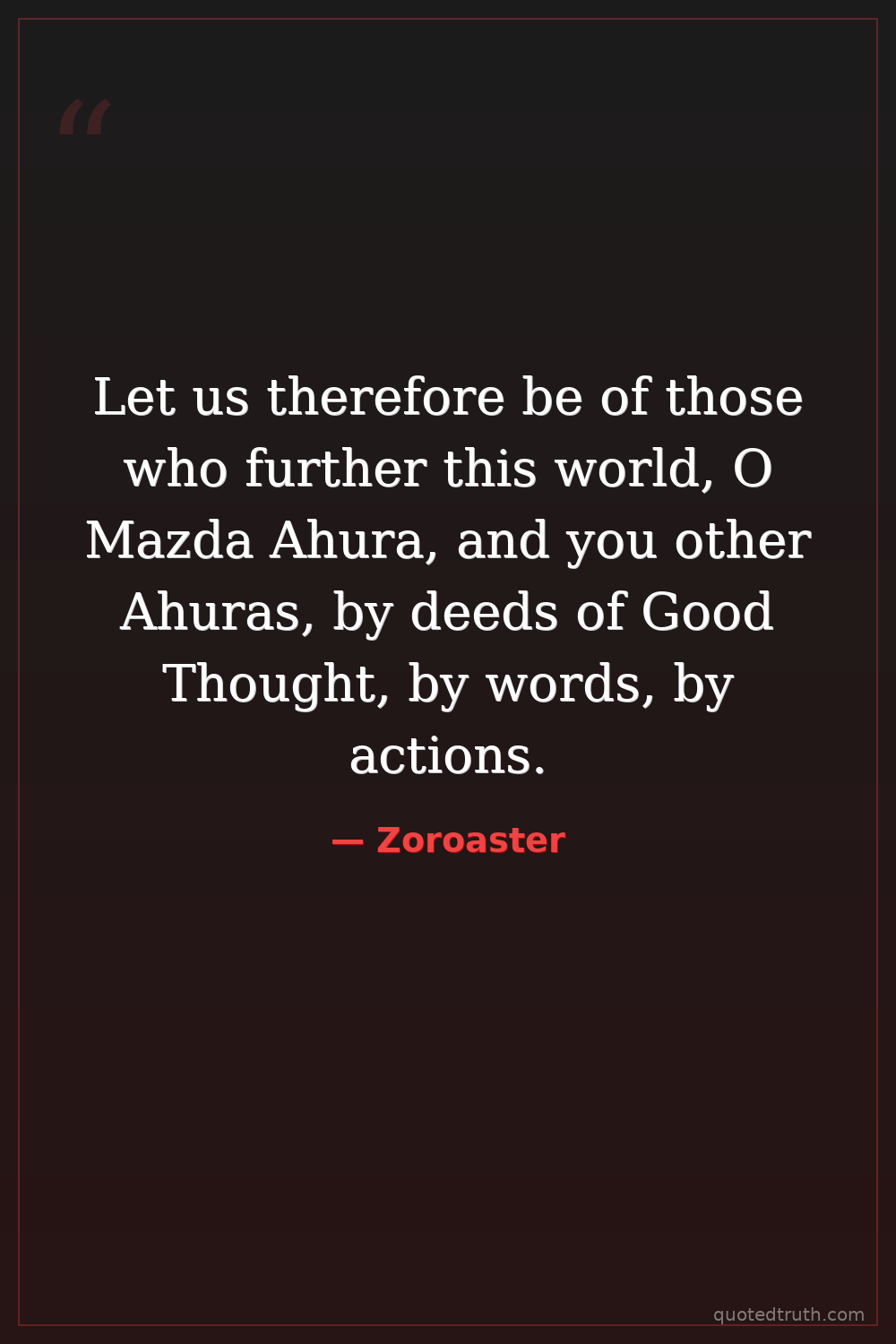
Zoroaster — "Let us therefore be of those who further this world, O Mazda Ahura, and you othe…"
Let us therefore be of those who further this world, O Mazda Ahura, and you other Ahuras, by deeds of Good Thought, by words, by actions.
Let us therefore be of those who further this world, O Mazda Ahura, and you other Ahuras, by deeds of Good Thought, by words, by actions.
Click any product to generate a realistic preview. Up to 3 at a time.
* Initial load can take up to 90 seconds — revising the preview in another color is nearly instant.
"The lie-follower is an evil doer, but the truth-follower is a good doer."
"One need not scale the heights of the heavens, nor travel along the highways of the world to find Ahura Mazda. With purity of mind and holiness of heart one can find Him in one's own heart."
"He who brings forth life for the cattle and cultivates the earth with righteousness, he is the one who serves Mazda."
"Whosoever, O Mazda, by his thoughts, words, and deeds makes a sacrifice to Thee, he shall be granted the best existence."
"In the radiance of righteousness, we shall learn self-knowledge and righteous thinking."
Iranian prophet who founded Zoroastrianism, the first major religion of cosmic dualism between good (Ahura Mazda) and evil (Angra Mainyu). Closely associated with The Buddha (near-contemporary Eastern moral-cosmological revolutionary). For an intellectual contrast, see Friedrich Nietzsche, German philosopher of 'beyond good and evil' — Nietzsche appropriated Zarathustra's name for Thus Spoke Zarathustra (1883) precisely to invert the original's moral cosmology — the historical Zoroaster founded the good-versus-evil framework Nietzsche's character announces the end of.
Found in 1 providers: grok
1 source checked
The speaker calls on listeners to actively improve the world through three aligned channels: thinking well, speaking well, and acting well. It is a plea to join the community of people who make reality better rather than worse. Progress is not passive hope or ritual alone; it requires ethical intention, honest speech, and practical effort working together. Goodness must be embodied, not merely believed.
This reflects Zoroaster's foundational doctrine of Humata, Hukhta, Hvarshta, good thoughts, good words, good deeds, the ethical triad every Zoroastrian is expected to live by. As a reforming priest who rejected the older Indo-Iranian ritual cults, he addresses Ahura Mazda directly and names the Ahuras as allies, framing humans as cosmic partners with the divine in the ongoing struggle to renovate and perfect creation.
Zoroaster lived in Bronze Age eastern Iran, roughly 1500 to 1000 BCE, among pastoral tribes practicing polytheistic sacrifice-heavy religion. His era saw tribal raiding, cattle rustling, and moral chaos he condemned. By elevating one wise lord, Ahura Mazda, and framing life as a choice between truth, asha, and the lie, druj, he pioneered ethical monotheism centuries before comparable movements, influencing later Judaism, Christianity, and Islam through Persian imperial contact.
AI-generated insights based on extensive research and information for context. Factual errors? Email [email protected].
Your cart is empty