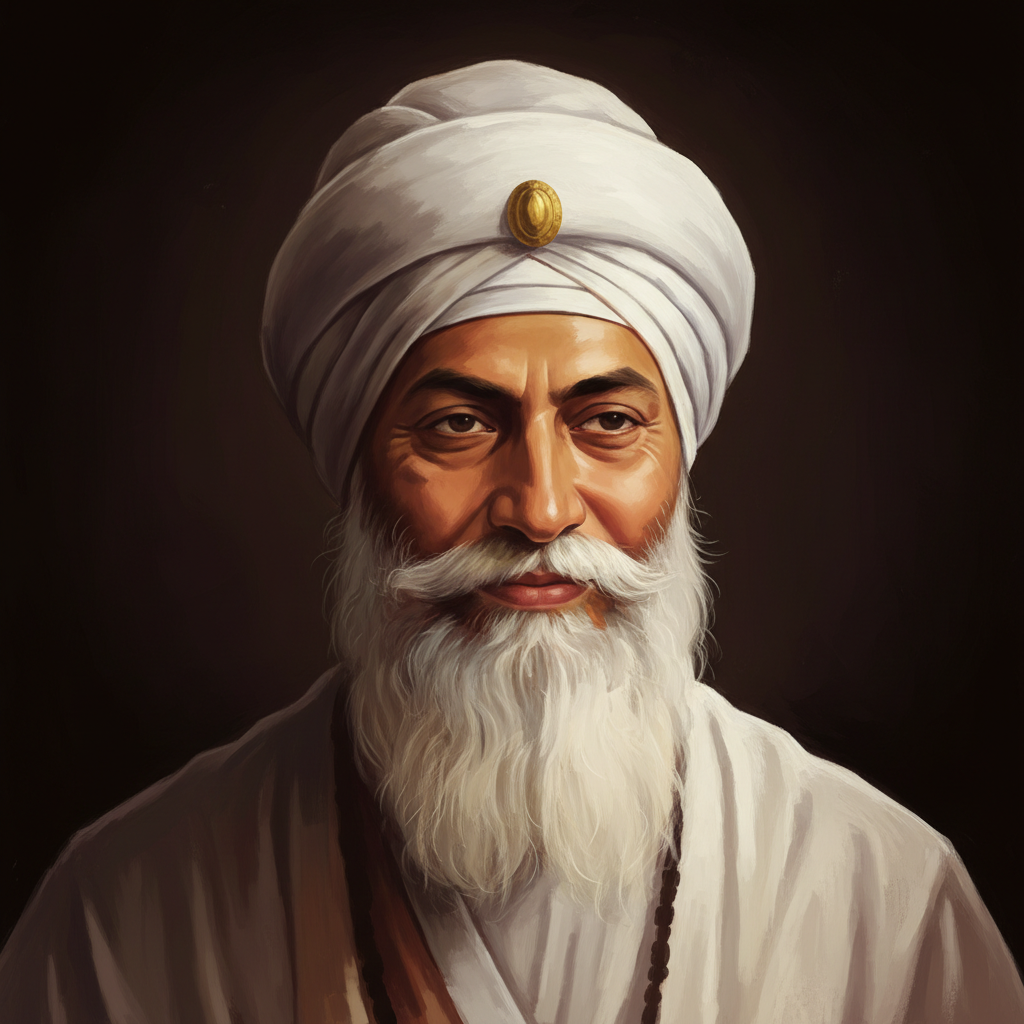
Guru Nanak — "Live in the world, but remain untouched by it, like a lotus in water."
Live in the world, but remain untouched by it, like a lotus in water.
Live in the world, but remain untouched by it, like a lotus in water.
Click any product to generate a realistic preview. Up to 3 at a time.
* Initial load can take up to 90 seconds — revising the preview in another color is nearly instant.
"Guru Nanak taught that depriving others of their rights is a serious moral offense."
"There is no Hindu and no Musalman."
"Even kings and emperors have vast riches and still they are not content. Probably because they can't find matching socks."
"Emotional attachment to Maya is totally painful, this is a bad bargain."
"The true Guru is the one who shows the path of truth and righteousness."
Founder of Sikhism and the first of the Ten Sikh Gurus, whose teachings of one universal God and rejection of caste shaped Punjab. Closely associated with Kabir (mystical poet whose verses appear in the Sikh Guru Granth Sahib). For an intellectual contrast, see Brahmanical orthodoxy, the Hindu caste-and-ritual establishment of his era — Sikhism was founded as a deliberate alternative to both Hindu ritual hierarchy and Islamic exclusivism — Nanak's universalism was a structural rejection of caste and priestly mediation.
Found in 1 providers: grok
1 source checked
Engage fully with everyday life—work, family, relationships, responsibilities—without letting its pressures, greed, anger, or attachments define you. A lotus grows in muddy ponds yet its petals repel the water and dirt around it. The saying asks you to participate in society rather than retreat from it, while keeping your inner values, integrity, and spiritual focus clean from the messiness you move through daily.
Guru Nanak rejected the ascetic tradition of abandoning the world for forest meditation. He worked as a granary accountant, married Sulakhani, raised two sons, and later farmed at Kartarpur while teaching. His three pillars—Naam Japna, Kirat Karni (honest labor), Vand Chakna (sharing)—demand worldly engagement. The lotus image captures his core teaching that householders, not hermits, can reach the divine through disciplined daily living.
In late 15th and early 16th century Punjab, Hindu ascetics renounced society for forests and caves, while Sufi mystics and Brahmin ritualists competed for spiritual authority under the Delhi Sultanate and early Mughals. Caste hierarchy and ritual purity dominated religious life. Nanak's message arrived as a radical middle path rejecting both renunciation and empty ritual, offering merchants, farmers, and laborers a direct spiritual path without abandoning their trades, families, or communities.
AI-generated insights based on extensive research and information for context. Factual errors? Email [email protected].
Your cart is empty