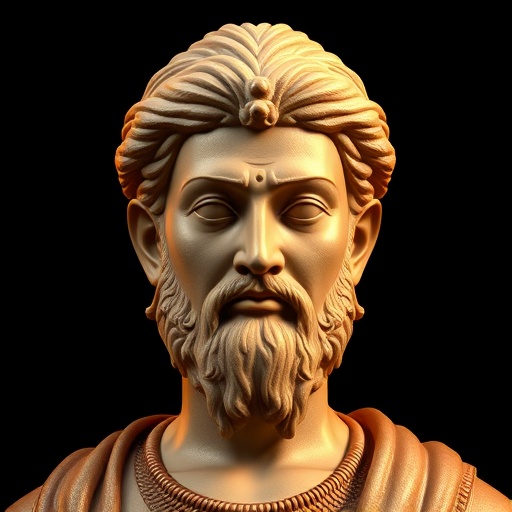
Mahavira — "Look at the world with the eyes of a friend."
Look at the world with the eyes of a friend.
Look at the world with the eyes of a friend.
Click any product to generate a realistic preview. Up to 3 at a time.
* Initial load can take up to 90 seconds — revising the preview in another color is nearly instant.
"The path to liberation is through right faith, right knowledge, and right conduct."
"The path of non-violence is the path of enlightenment."
"The soul is the only reality; everything else is transient."
"The essence of knowledge is to know the self."
"There is no quality of soul more subtile than non-attachment."
24th and last Tirthankara of Jainism, whose teachings of strict ahimsa (non-violence), aparigraha (non-attachment), and karma reshaped ancient Indian religion. Closely associated with The Buddha (near-contemporary moral revolutionary, also reacting against Vedic ritualism). For an intellectual contrast, see Vedic Brahmanical ritual sacrifice, the animal-sacrifice-centered Vedic religion of his era — Mahavira's ahimsa demanded total non-violence, including not eating root vegetables that kill the plant — a maximum-distance ethical move from the Vedic priestly tradition that ritually sacrificed cattle and horses. The two cleanest poles of ancient Indian religious ethics.
Found in 1 providers: grok
1 source checked
Treat every person, creature, and situation with the natural warmth, patience, and goodwill you'd extend to someone you love. A friend gets your benefit of the doubt; you notice their strengths before their flaws. Applied universally, this posture dissolves hostility, competition, and indifference, replacing them with empathy and genuine care. It is a practical directive: shift your default perception from judgment or neutrality to active benevolence toward all life.
Mahavira renounced his princely life at 30, spending 12 years in extreme asceticism before attaining enlightenment. His core doctrine, ahimsa, demanded not just avoiding harm but actively cultivating benevolence toward every soul. He taught that all living beings possess an eternal soul, jiva, of equal worth, directly embodying the friend metaphor. His monastic order famously admitted both men and women, extending this egalitarian friendship across the rigid caste and gender lines of his society.
Mahavira lived during the Axial Age, around the 6th century BCE, when Vedic Brahminism stratified society rigidly by birth caste. Social relations were governed by hierarchy and ritual purity, not empathy. This was also the era of the Buddha and early Upanishadic thought. Mahavira's call to befriend the world was radical counter-programming, dismantling inherited social rankings and replacing duty-to-caste with universal compassion extended equally to humans, animals, and even microscopic life.
AI-generated insights based on extensive research and information for context. Factual errors? Email [email protected].
Your cart is empty