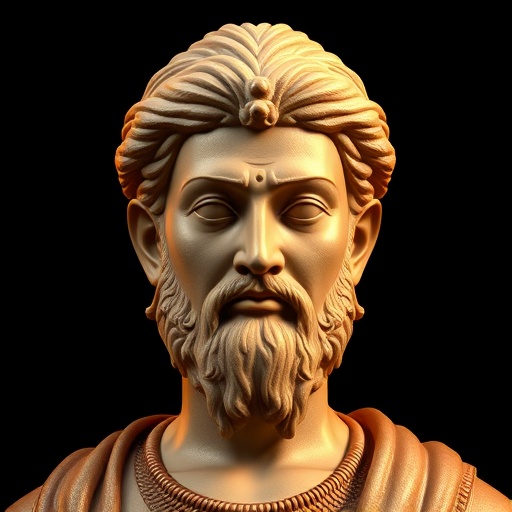
Mahavira — "The path of non-violence is the path of enlightenment."
The path of non-violence is the path of enlightenment.
The path of non-violence is the path of enlightenment.
Click any product to generate a realistic preview. Up to 3 at a time.
* Initial load can take up to 90 seconds — revising the preview in another color is nearly instant.
"Renunciation is the key to eternal happiness."
"Respect for all living beings is Jainism."
"The soul is pure, eternal, and full of infinite knowledge, vision, power, and bliss."
"There is no quality of soul more subtile than non-attachment."
"Do not indulge in unnecessary talk."
24th and last Tirthankara of Jainism, whose teachings of strict ahimsa (non-violence), aparigraha (non-attachment), and karma reshaped ancient Indian religion. Closely associated with The Buddha (near-contemporary moral revolutionary, also reacting against Vedic ritualism). For an intellectual contrast, see Vedic Brahmanical ritual sacrifice, the animal-sacrifice-centered Vedic religion of his era — Mahavira's ahimsa demanded total non-violence, including not eating root vegetables that kill the plant — a maximum-distance ethical move from the Vedic priestly tradition that ritually sacrificed cattle and horses. The two cleanest poles of ancient Indian religious ethics.
Found in 1 providers: grok
1 source checked
True wisdom and spiritual awakening come through refusing to harm any living being. Non-violence isn't weakness or passivity but an active, disciplined commitment that purifies the soul and dissolves karmic bondage, ultimately liberating consciousness from the cycle of rebirth and suffering that traps unenlightened beings.
Mahavira renounced royal privilege at 30, lived naked, endured physical hardships without retaliation, and practiced absolute ahimsa toward insects, plants, and humans alike. His 12 years of silent meditation modeled this principle as lived reality, not philosophy. Non-violence was the structural core of the Jain monastic code he systematized.
6th-century BCE India was defined by Brahminical ritual sacrifice involving animal killing and rigid caste hierarchies justifying structural violence. Mahavira's contemporary Buddha shared similar reformist instincts. Both movements emerged amid urbanization and merchant-class questioning of Vedic orthodoxy, making ahimsa a radical political and spiritual challenge to the dominant sacrificial religious economy.
AI-generated insights based on extensive research and information for context. Factual errors? Email [email protected].
Your cart is empty