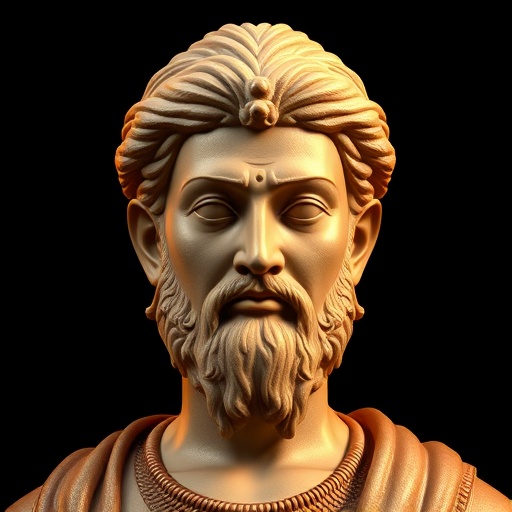
Mahavira — "The path to liberation is through right faith, right knowledge, and right conduc…"
The path to liberation is through right faith, right knowledge, and right conduct.
The path to liberation is through right faith, right knowledge, and right conduct.
Click any product to generate a realistic preview. Up to 3 at a time.
* Initial load can take up to 90 seconds — revising the preview in another color is nearly instant.
"The real self is beyond all forms of karma."
"The path of non-violence is the path of enlightenment."
"Have compassion towards all living beings. Hatred leads to destruction."
"The path of purification is the path of non-violence, self-control, and penance."
"The path of purification is the path of liberation."
24th and last Tirthankara of Jainism, whose teachings of strict ahimsa (non-violence), aparigraha (non-attachment), and karma reshaped ancient Indian religion. Closely associated with The Buddha (near-contemporary moral revolutionary, also reacting against Vedic ritualism). For an intellectual contrast, see Vedic Brahmanical ritual sacrifice, the animal-sacrifice-centered Vedic religion of his era — Mahavira's ahimsa demanded total non-violence, including not eating root vegetables that kill the plant — a maximum-distance ethical move from the Vedic priestly tradition that ritually sacrificed cattle and horses. The two cleanest poles of ancient Indian religious ethics.
Tattvartha Sutra (though this text was compiled later, it reflects Mahavira's teachings)
Date: circa 5th-6th century BCE (core teaching)
EducationalFound in 1 providers: grok
1 source checked
Liberation from suffering and the cycle of rebirth requires three aligned elements: genuine belief in correct principles, accurate understanding of reality, and ethical behavior in daily life. All three must work together — belief without knowledge is blind, knowledge without right conduct is hollow, and conduct without proper understanding lacks direction. Together they form a complete, self-reinforcing path toward spiritual freedom.
Mahavira spent twelve years in intense ascetic practice, renouncing possessions, family, and comfort to pursue exactly this threefold path. As the 24th Tirthankara who achieved omniscience, he embodied the integration of faith, knowledge, and conduct. His entire teaching system — the Jain Agamas — systematizes these three jewels as the foundation of liberation, reflecting his own disciplined journey to enlightenment.
In 6th century BCE India, spiritual seekers were challenging Vedic orthodoxy and Brahmin authority. Alongside the Buddha, Mahavira offered a path accessible through personal discipline rather than ritual sacrifice or priestly mediation. The emphasis on right conduct resonated in a society stratified by caste, as it implied moral agency belonged to the individual regardless of birth, making liberation a universal possibility rather than a hereditary privilege.
AI-generated insights based on extensive research and information for context. Factual errors? Email [email protected].
Your cart is empty