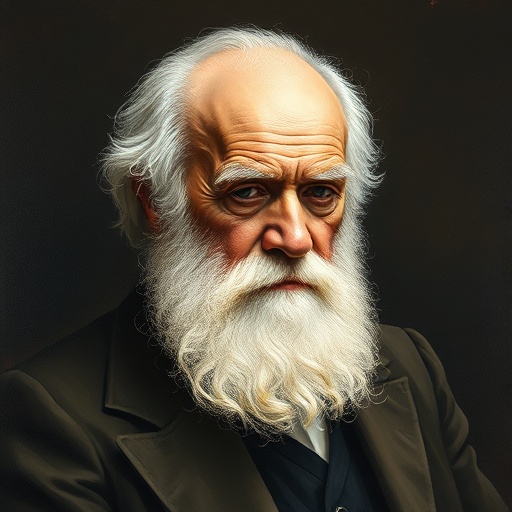
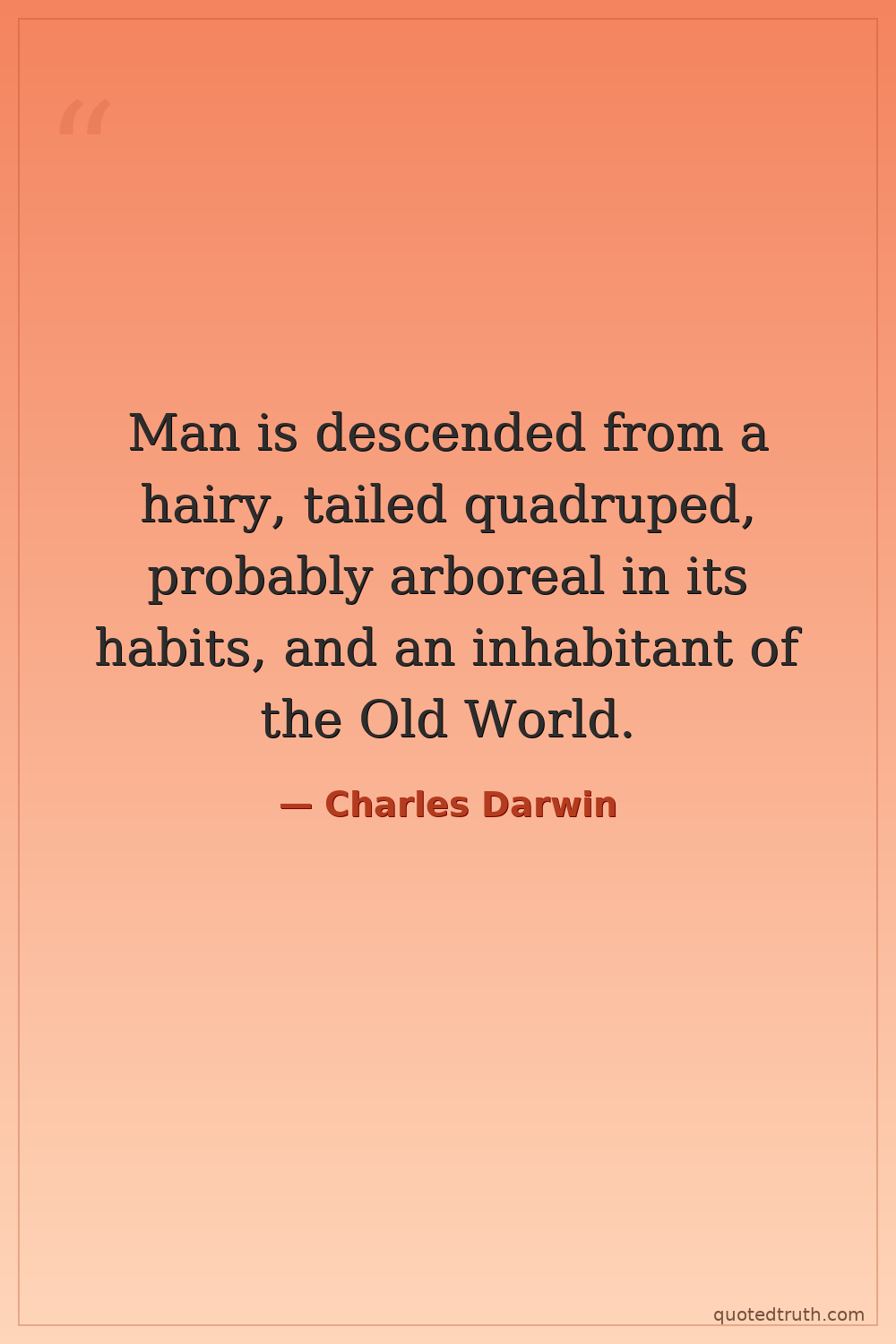
Charles Darwin — "Man is descended from a hairy, tailed quadruped, probably arboreal in its habits…"
Man is descended from a hairy, tailed quadruped, probably arboreal in its habits, and an inhabitant of the Old World.
Man is descended from a hairy, tailed quadruped, probably arboreal in its habits, and an inhabitant of the Old World.
Click any product to generate a realistic preview. Up to 3 at a time.
* Initial load can take up to 90 seconds — revising the preview in another color is nearly instant.
"My mind seems to have become a kind of machine for grinding general laws out of large collections of facts."
"I have steadily endeavoured to keep my mind free so as to give up any hypothesis, however much beloved, as soon as facts are shown to be opposed to it."
"We are like a judge who has to sum up and deliver judgment, not on the evidence of witnesses, but on the arguments of counsel."
"The mystery of the beginning of all things is insoluble by us; and I for one must be content to remain an agnostic."
"I am turned into a sort of machine for observing facts and grinding out generalizations."
British naturalist whose On the Origin of Species (1859) established evolution by natural selection — the unifying theory of modern biology. Closely associated with Thomas Henry Huxley (his 'bulldog' public defender) and Alfred Russel Wallace (independent co-discoverer of natural selection). For an intellectual contrast, see William Paley, Anglican theologian and Natural Theology author (1743-1805) — Origin of Species is structurally a 400-page reply to Paley — Darwin admired Paley's watchmaker-argument as an undergraduate at Cambridge and then spent 20 years building the empirical machinery to displace him. The cleanest 'design argument vs natural selection' founding rebuttal in science.
The standard scholarly entry points to Charles Darwin's work: Janet Browne (Harvard, history of science) — Charles Darwin: Voyaging (1995) and The Power of Place (2002); Adrian Desmond (UCL, biographer) — Darwin: The Life of a Tormented Evolutionist (1991, with James Moore). These are the works graduate seminars cite when teaching Charles Darwin.
Found in 1 providers: grok
1 source checked
Humans descended from a tree-dwelling, tailed, ape-like creature that lived in Africa or Asia. Darwin is making a blunt, scientific claim: we are not separately created beings but animals shaped by the same evolutionary forces as every other species. He places Homo sapiens inside the animal kingdom without apology, stripping away the idea that humanity occupies a special, divinely ordained position above the rest of nature.
Darwin spent decades avoiding this exact statement. In On the Origin of Species (1859) he deliberately sidestepped human origins. This quote appears in The Descent of Man (1871), where he finally committed fully. His Beagle voyage exposed him to human diversity worldwide, and his meticulous anatomical comparisons of humans to apes gave him the evidence he needed. The delay reflects how personally costly he knew this specific conclusion would be.
In 1871 Victorian England, the Church of England treated Genesis as literal truth and human uniqueness as theological fact. The 1860 Oxford debate between Thomas Huxley and Bishop Wilberforce had already shocked Britain with evolution's implications. Colonialism also made shared human ancestry politically volatile, since empire's racial hierarchies depended on ranking humans as fundamentally unequal. Darwin's claim that all humans share a common primate ancestor threatened both religious doctrine and the ideological scaffolding of British imperialism.
AI-generated insights based on extensive research and information for context. Factual errors? Email [email protected].
Your cart is empty