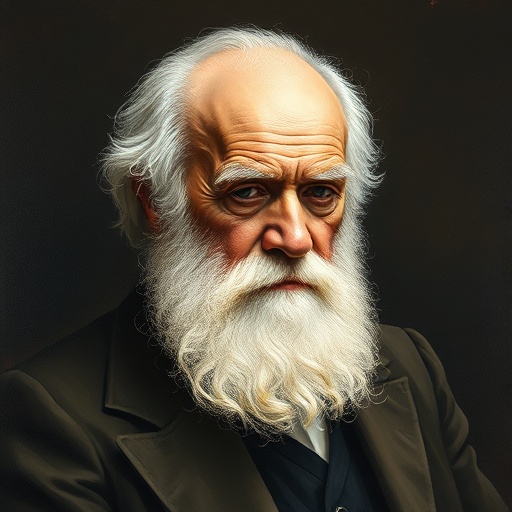
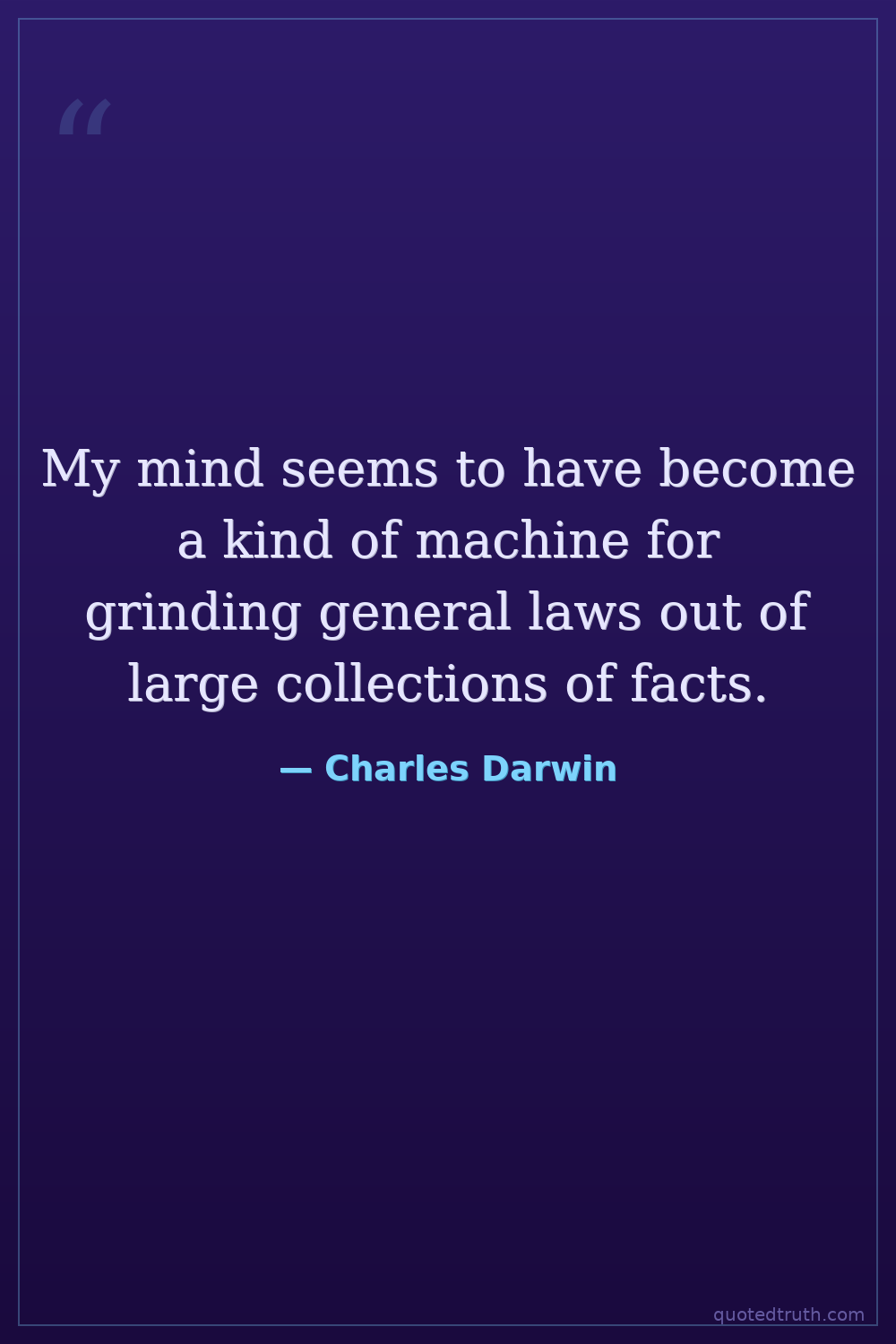
Charles Darwin — "My mind seems to have become a kind of machine for grinding general laws out of …"
My mind seems to have become a kind of machine for grinding general laws out of large collections of facts.
My mind seems to have become a kind of machine for grinding general laws out of large collections of facts.
Click any product to generate a realistic preview. Up to 3 at a time.
* Initial load can take up to 90 seconds — revising the preview in another color is nearly instant.
"I hate a Barnacle as no man ever did before, not even a Sailor in a slow-sailing ship."
"It has been said that the love of money is the root of all evil. The want of money is so quite as truly."
"A scientific man ought to have no wishes, no affections – a mere heart of stone."
"But I am very poorly today and very stupid and hate everybody and everything."
"The expression of the emotions in man and animals."
British naturalist whose On the Origin of Species (1859) established evolution by natural selection — the unifying theory of modern biology. Closely associated with Thomas Henry Huxley (his 'bulldog' public defender) and Alfred Russel Wallace (independent co-discoverer of natural selection). For an intellectual contrast, see William Paley, Anglican theologian and Natural Theology author (1743-1805) — Origin of Species is structurally a 400-page reply to Paley — Darwin admired Paley's watchmaker-argument as an undergraduate at Cambridge and then spent 20 years building the empirical machinery to displace him. The cleanest 'design argument vs natural selection' founding rebuttal in science.
The standard scholarly entry points to Charles Darwin's work: Janet Browne (Harvard, history of science) — Charles Darwin: Voyaging (1995) and The Power of Place (2002); Adrian Desmond (UCL, biographer) — Darwin: The Life of a Tormented Evolutionist (1991, with James Moore). These are the works graduate seminars cite when teaching Charles Darwin.
Found in 2 providers: deepseek,grok
2 sources checked
Darwin describes his thinking process as purely mechanical and systematic — he takes mountains of raw observations and data, then extracts universal patterns and principles from them. He's essentially describing inductive reasoning at an extreme scale. The quote also carries quiet regret: his mind has been transformed by scientific work into something more like a processing engine than a creative, feeling intellect.
Darwin wrote this in his autobiography, expressing melancholy at losing his earlier love of poetry, music, and fine art. After five years aboard the Beagle collecting specimens across South America and the Pacific, then decades of systematic barnacle studies and correspondence with breeders worldwide, his mind had genuinely been retrained by scientific method. He pioneered building grand theories from exhaustive empirical accumulation — evolution by natural selection being the supreme example.
Darwin lived through the Victorian Industrial Revolution, when Britain's factories and machines reshaped civilization. His machine metaphor resonated deeply: Victorians were obsessed with systematic efficiency. Simultaneously, natural theology — the belief that nature's design proved God — dominated educated culture. Darwin's empirical method directly challenged this. His era also saw the rise of geology, statistics, and scientific societies demanding evidence-based argument over philosophical speculation, making his fact-grinding approach both revolutionary and timely.
AI-generated insights based on extensive research and information for context. Factual errors? Email [email protected].
Your cart is empty