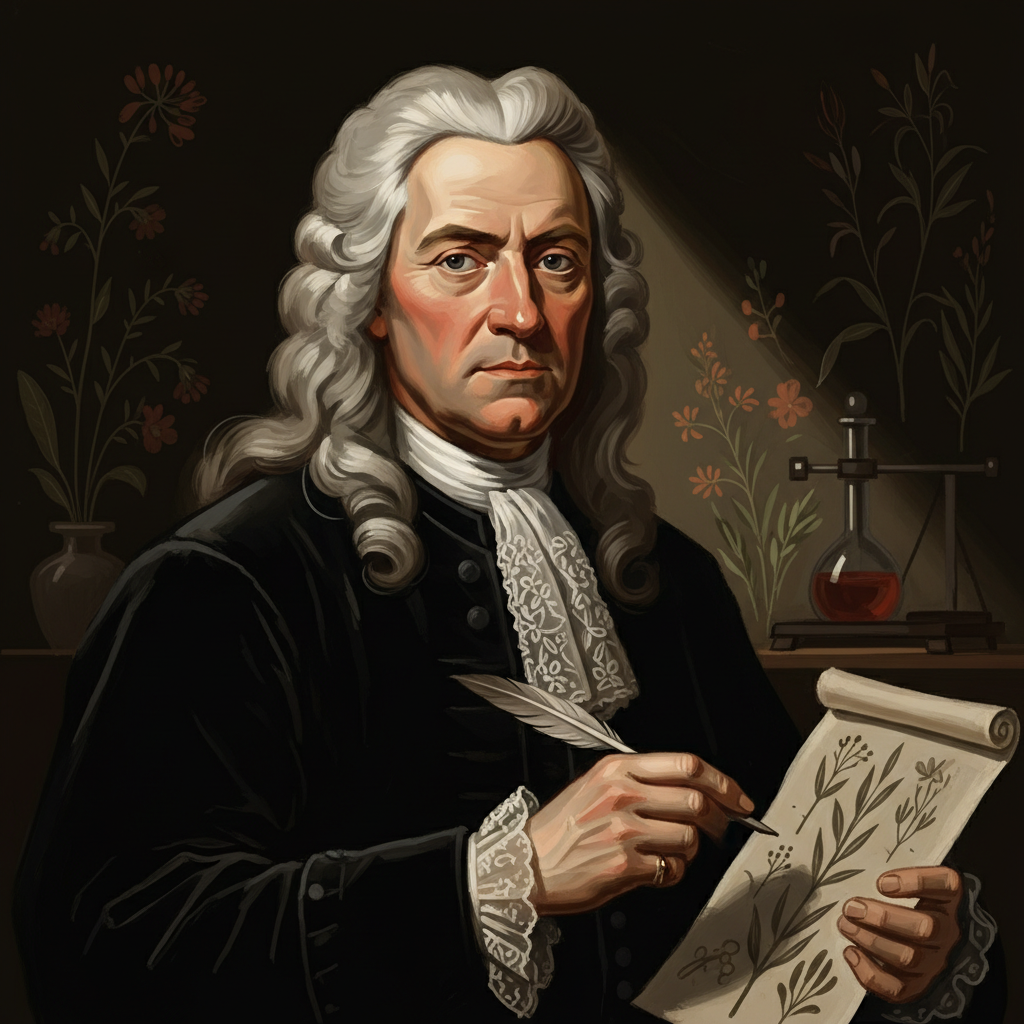
Carl Linnaeus — "Man is the measure of all things, but the Creator is the measure of man."
Man is the measure of all things, but the Creator is the measure of man.
Man is the measure of all things, but the Creator is the measure of man.
Click any product to generate a realistic preview. Up to 3 at a time.
* Initial load can take up to 90 seconds — revising the preview in another color is nearly instant.
"The classes are for the genera, the genera for the species, the species for the individuals."
"By a botanist I mean one who understands how to observe the genera of Nature. I judge unworthy of the name of botanist the meddlesome person who is indifferent to genera."
"All species of the same genus form a natural group, and all genera of the same order form a natural group."
"The whole of natural history depends on the accurate knowledge of species."
"The whole system of nature is nothing but a system of sexual generation."
Swedish botanist and the father of modern taxonomy whose Systema Naturae (1735) introduced binomial nomenclature for naming all species. Closely associated with Joseph Banks (British naturalist who carried Linnaean classification on Cook's voyages). For an intellectual contrast, see Comte de Buffon, French naturalist and Histoire Naturelle author (1749-1788) — Buffon explicitly attacked Linnaean fixed-categories taxonomy as artificial and rejected the binomial system; his gradualist, environment-shaped natural history was the explicit alternative. Anticipates the fixed-species-vs-evolution debate Darwin would later resolve.
A philosophical and theological statement placing humanity within a divine hierarchy.
Date: Uncertain (attributed)
Art & CreativityFound in 1 providers: gemini
1 source checked
Humans perceive and interpret everything through their own perspective — we are the lens through which reality is understood. But the quote adds a crucial inversion: God sits above humanity as the ultimate standard. Human judgment is real and central, yet bounded and accountable to divine authority. This isn't anti-science; it's a hierarchy where human reason operates within divinely set limits. Power flows downward from Creator to creation.
Linnaeus spent his life classifying all living things in Systema Naturae, explicitly framing taxonomy as reading God's blueprint. He named humans Homo sapiens — placing us within nature yet apart. He wrote that God created; Linnaeus organized. His religious faith was inseparable from his science; he saw botanical order as divine language. This quote captures his dual conviction: human reason as the instrument, divine design as the governing text behind it.
Linnaeus worked during the Enlightenment's height, when human reason was ascending to challenge church authority. Natural philosophy was reframing the cosmos as mechanistic and measurable. Yet most naturalists, including Linnaeus, operated within natural theology — science as proof of God's design. The tension between humanist confidence and religious humility defined the period. Classifying creation meant honoring the Creator; taxonomy was simultaneously rational science and an act of devotion.
AI-generated insights based on extensive research and information for context. Factual errors? Email [email protected].
Your cart is empty