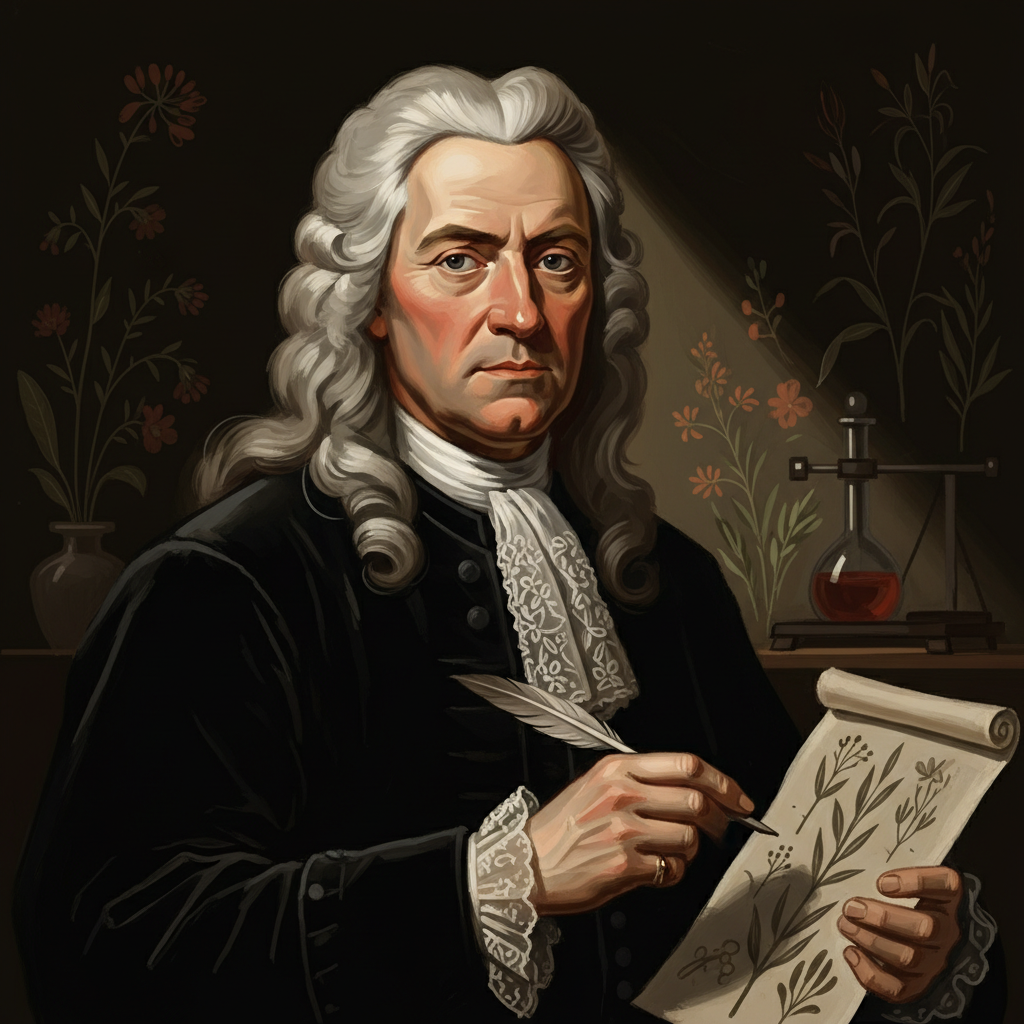
Carl Linnaeus — "The whole of natural history depends on the accurate knowledge of species."
The whole of natural history depends on the accurate knowledge of species.
The whole of natural history depends on the accurate knowledge of species.
Click any product to generate a realistic preview. Up to 3 at a time.
* Initial load can take up to 90 seconds — revising the preview in another color is nearly instant.
"The classification of plants is the most difficult of all tasks."
"Homo Sapiens. Diurnus; varians cultura, loco. Europaeus albus, Asiaticus luridus, Africanus niger, Americanus rufus."
"Human beings, having, above all creatures, received the power of reason... need to be aware where nature is unaware. Nature reaches its culmination in humans, but human consciousness has not its essen…"
"The purpose of science is to know the works of God."
"The world is ruled by three things: money, women, and botany."
Swedish botanist and the father of modern taxonomy whose Systema Naturae (1735) introduced binomial nomenclature for naming all species. Closely associated with Joseph Banks (British naturalist who carried Linnaean classification on Cook's voyages). For an intellectual contrast, see Comte de Buffon, French naturalist and Histoire Naturelle author (1749-1788) — Buffon explicitly attacked Linnaean fixed-categories taxonomy as artificial and rejected the binomial system; his gradualist, environment-shaped natural history was the explicit alternative. Anticipates the fixed-species-vs-evolution debate Darwin would later resolve.
A foundational statement on his methodological approach to natural science.
Date: c. 1730s
EducationalFound in 1 providers: gemini
1 source checked
Understanding all of nature — how organisms relate, interact, and fit into ecosystems — requires first knowing exactly what each organism is. Without correctly distinguishing one species from another, observations become unreliable, comparisons meaningless, and conclusions impossible to reproduce. Species identification is the foundation: get it wrong, and every study built on top collapses. Rigorous, consistent naming isn't pedantry — it's the prerequisite for all biological science.
Linnaeus spent his career solving precisely this problem. His 1735 Systema Naturae introduced binomial nomenclature — assigning every organism a two-part Latin name — creating a universal language for biology. He personally classified roughly 7,700 plants and 4,400 animals. Having witnessed firsthand how inconsistent naming across naturalists created confusion and duplication, this quote is effectively his mission statement: systematic classification isn't optional, it is natural history.
The 18th century was Europe's great age of exploration — ships returned from the Americas, Asia, and Africa carrying specimens no European had named. Thousands of new organisms flooded natural historians with no shared naming system. Different countries and scholars used conflicting names for identical species. The Enlightenment's demand for rational order made Linnaeus's approach urgent: his binomial system arrived precisely when biological knowledge threatened to collapse under its own disorganized abundance.
AI-generated insights based on extensive research and information for context. Factual errors? Email [email protected].
Your cart is empty