What it means
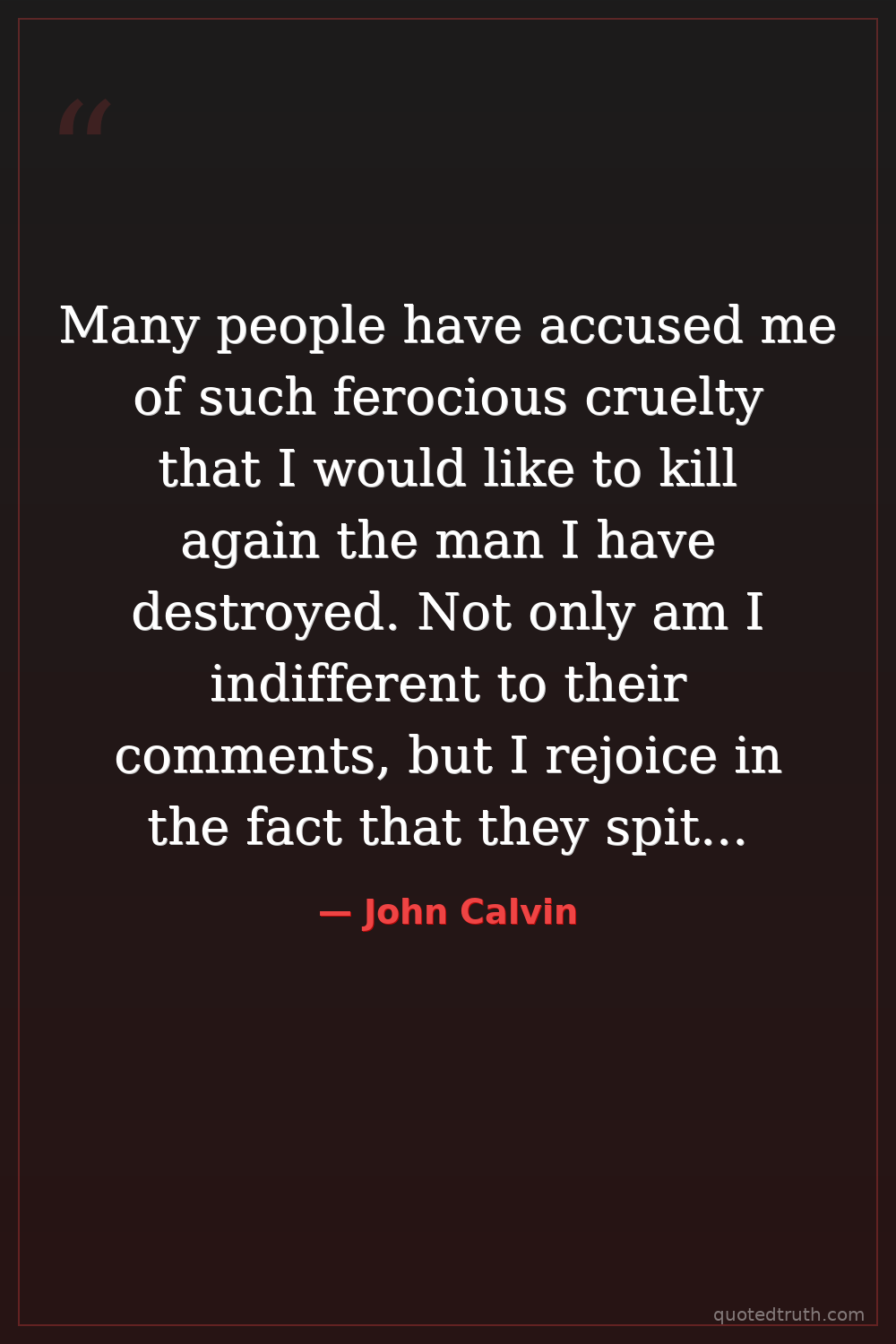
The quote expresses Calvin's defiant, unapologetic stance toward critics who condemned him for executing a perceived heretic. He acknowledges accusations of cruelty but dismisses them completely, going further to say he takes pride in being despised by opponents. It reveals a conviction that defending doctrinal purity justified lethal punishment, and that public condemnation only confirmed his righteousness in God's eyes — disapproval from the wrong people was a badge of honor.
Relevance to John Calvin
This almost certainly references the 1553 burning of Michael Servetus, the anti-Trinitarian physician Calvin had arrested, tried, and executed for heresy in Geneva. As the city's dominant theological authority, Calvin spent his career enforcing strict doctrinal discipline, believing God's honor demanded harsh penalties for false teaching. His defiant pride reflects his core conviction that godly duty supersedes human approval — a principle driving his entire reform program and his concept of God's absolute sovereignty.
The era
The Protestant Reformation shattered Western Christianity's unity, triggering violent doctrinal conflict across Europe. Executing heretics was standard practice in both Catholic and Protestant territories. Servetus's burning sparked rare debate even among fellow Protestants — Sebastian Castellio openly challenged Calvin's right to kill for belief, producing one of history's earliest arguments for religious toleration. In this era where theological error was treated as treason against God and civil order, Calvin's unapologetic stance was extreme yet symptomatic of Reformation-era absolutism.
AI-generated insights based on extensive research and information for context. Factual errors? Email [email protected].