What it means
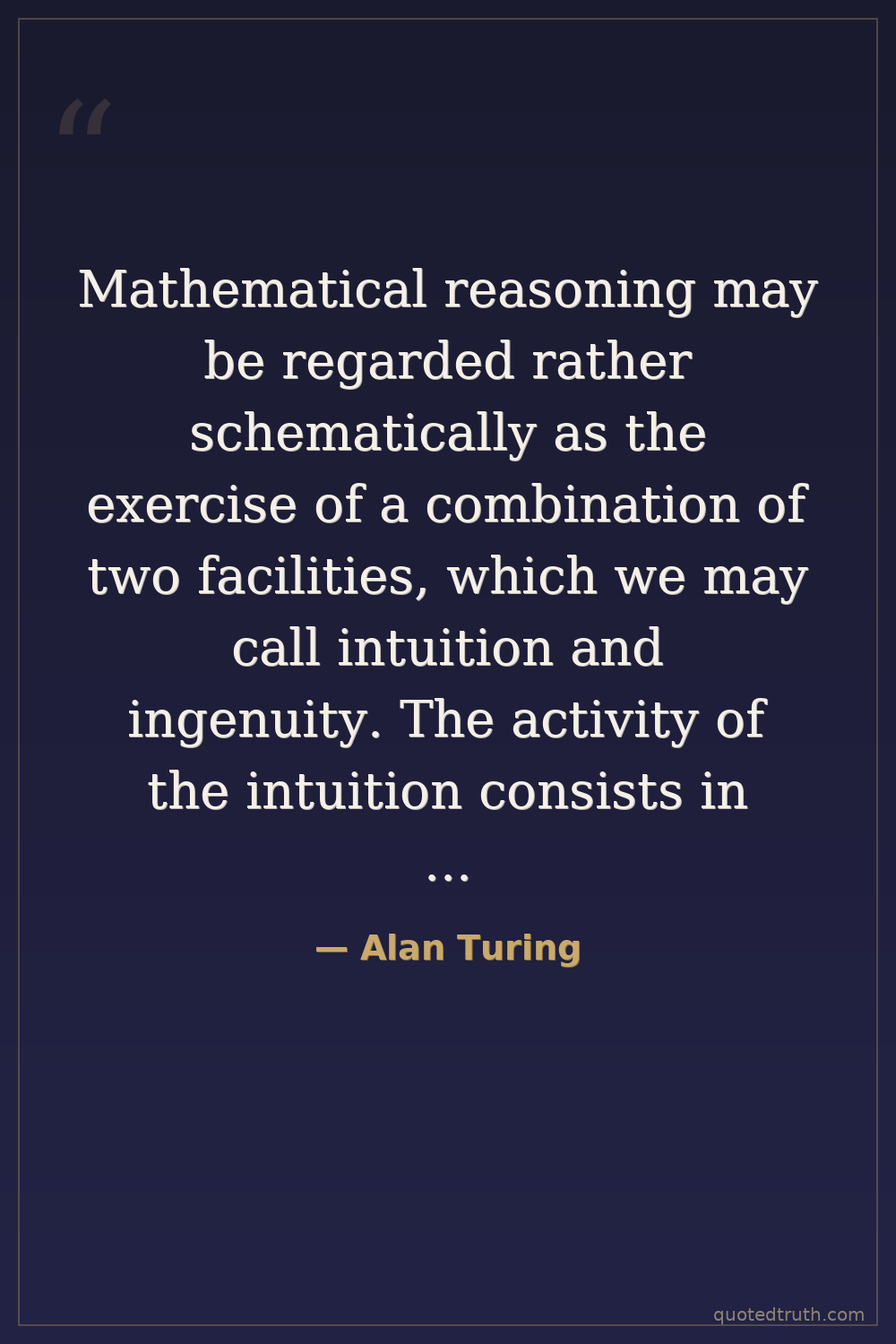
Mathematical thinking involves two distinct mental operations: intuition—those sudden, unexplained insights that arrive without deliberate reasoning—and ingenuity, the creative application of method. Turing argues that intuition produces valid mathematical judgments spontaneously, outside conscious logical steps. This challenges the assumption that all valid thought must be mechanically traceable. Human mathematical understanding involves flashes of recognition that precede and exceed any formal proof chain, making the mind irreducible to pure step-by-step procedure.
Relevance to Alan Turing
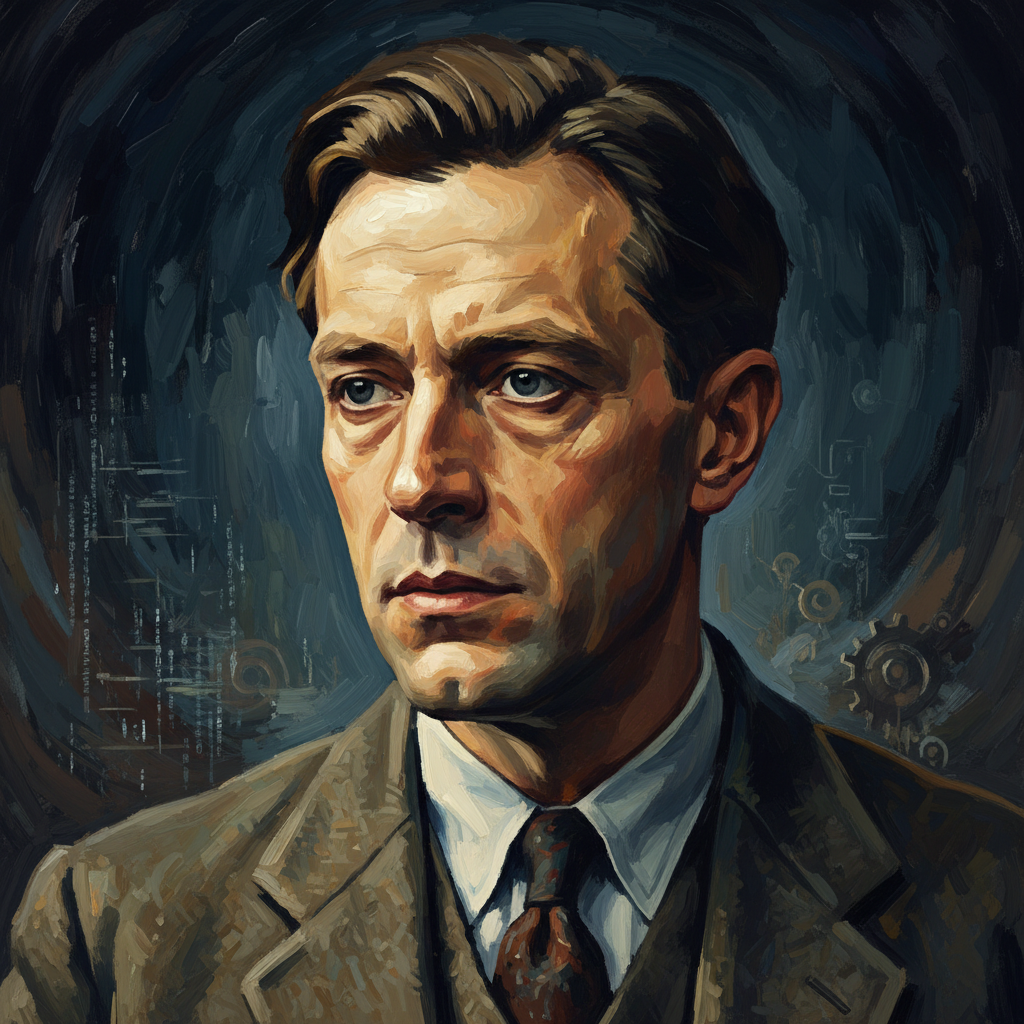
This quote comes from Turing's 1939 Princeton PhD thesis on ordinal logic, written as he was formalizing computation itself. It reveals his lifelong preoccupation: can machines replicate human thought? By identifying intuition as something beyond mechanical procedure, Turing implicitly defined the boundary his own Turing machines could not cross. This tension directly seeded the Turing Test—his attempt to ask whether machines could produce outputs indistinguishable from minds that possess genuine intuition.
The era
Written in 1939, this quote emerged amid a crisis in mathematical foundations. Gödel's 1931 incompleteness theorems had shattered Hilbert's dream of fully formalizing all mathematical truth, proving some truths lie beyond any formal system. Turing himself had just published his groundbreaking 1936 paper defining computable functions and the universal machine. Against this backdrop, what human mathematical intuition adds beyond any mechanical process was the defining intellectual problem of the age.
AI-generated insights based on extensive research and information for context. Factual errors? Email [email protected].