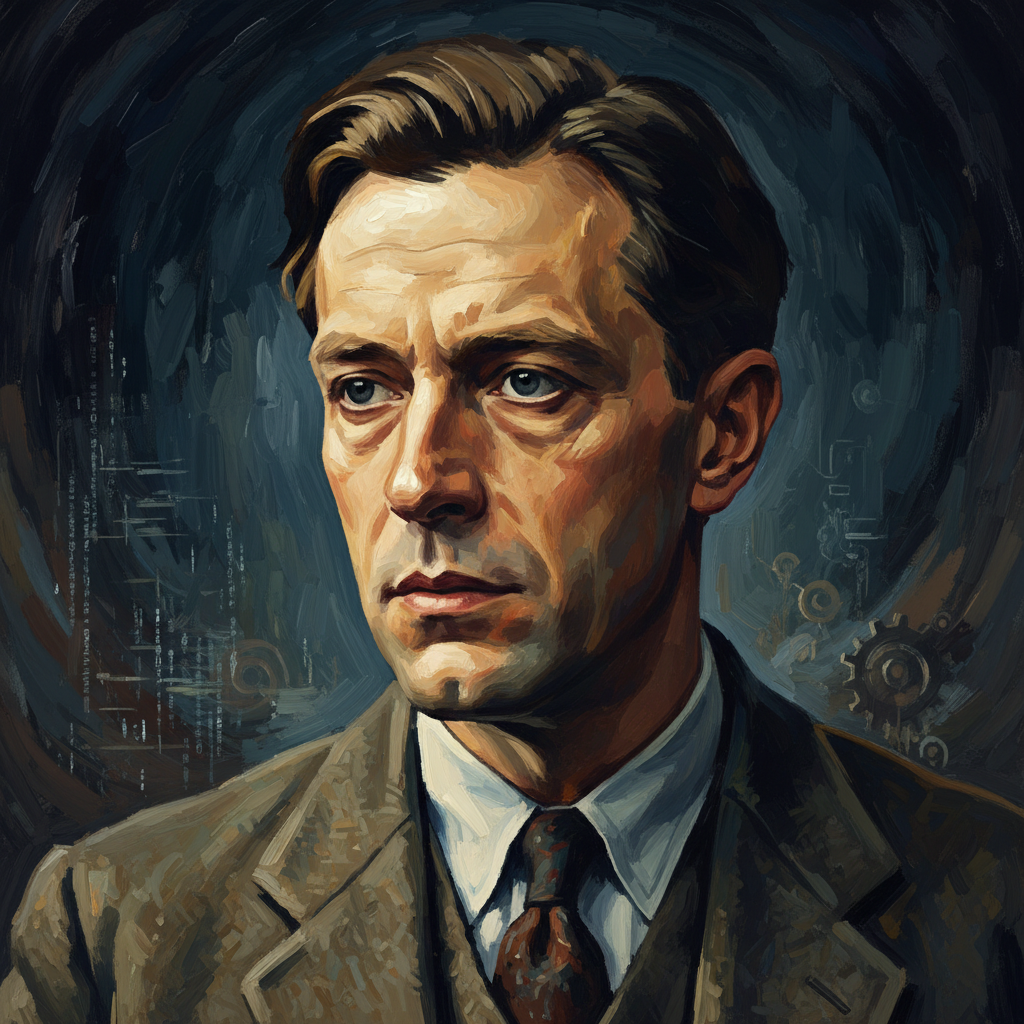
Alan Turing — "The human brain has a finite number of states, and so it can be simulated by a f…"
The human brain has a finite number of states, and so it can be simulated by a finite state machine.
The human brain has a finite number of states, and so it can be simulated by a finite state machine.
Click any product to generate a realistic preview. Up to 3 at a time.
* Initial load can take up to 90 seconds — revising the preview in another color is nearly instant.
"I believe that in about fifty years' time it will be possible to programme computers, with a storage capacity of about 10^9, to make them play the imitation game so well that an average interrogator w…"
"The machine cannot do anything new."
"I am not very impressed with theological arguments whatever they may be used to support. Such arguments have often been found unsatisfactory in the past. In the time of Galileo it was argued that the …"
"The machine should be able to communicate with human beings."
"The view that machines cannot give rise to surprises is due, I believe, to a fallacy to which philosophers and mathematicians are particularly subject. This is the assumption that as soon as a fact is…"
Attributed, theoretical implication from his work, but exact quote is elusive.
Date: Approx. 1950s
ShockingFound in 1 providers: grok
1 source checked
Every human thought, decision, and mental process arises from a brain that operates through a limited number of distinct physical configurations. Because the brain is finite and physical, its behavior can theoretically be replicated by a machine that cycles through an equivalent set of states. This challenges the idea that human minds are fundamentally different from mechanical processes or that consciousness requires something beyond computation.
Turing spent his career proving machines could replicate intelligent behavior, most famously designing the Turing Test to assess machine intelligence. His 1950 paper 'Computing Machinery and Intelligence' directly argued minds are computable. Having built Colossus-era computing machinery and conceived the universal Turing machine, he applied his own mathematical frameworks to biology, treating the brain as just another information-processing system.
In the late 1940s and early 1950s, digital computers were newly born and debates raged about whether machines could ever truly think. Behaviorism dominated psychology, and neuroscience was primitive. Turing's claim was radical: it collapsed the sacred boundary between human mind and mechanical device at a moment when Cold War anxieties made questions of machine intelligence both urgent and politically charged.
AI-generated insights based on extensive research and information for context. Factual errors? Email [email protected].
Your cart is empty