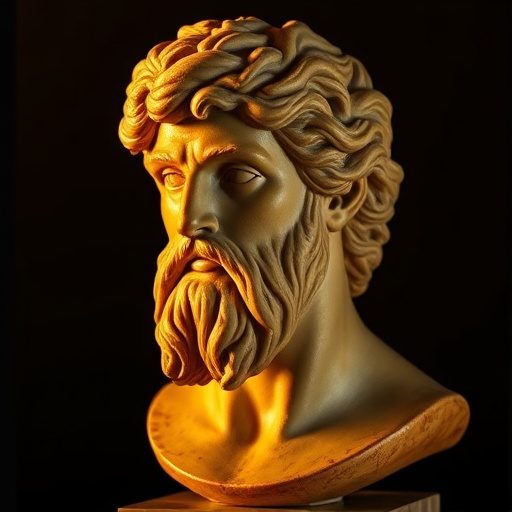
Pythagoras — "Do not wear a tight shoe."
Do not wear a tight shoe.
Do not wear a tight shoe.
Click any product to generate a realistic preview. Up to 3 at a time.
* Initial load can take up to 90 seconds — revising the preview in another color is nearly instant.
"Lust weakens both body and mind."
"When abroad, don't turn back at the border."
"Do not speak a little on many subjects, but much on a few."
"Above all things, reverence yourself."
"The soul is a self-moving number."
Greek philosopher and mathematician whose school in Croton combined geometry (the Pythagorean theorem), number-mysticism, and a religious-vegetarian way of life. Closely associated with Thales of Miletus (earlier pre-Socratic and the first philosopher). For an intellectual contrast, see Heraclitus, pre-Socratic Greek philosopher of flux — Heraclitus called Pythagoras 'the chief of swindlers' — among the founding insults of the philosophical-rivalry tradition. Their 'all is flux' vs 'all is number' poles still organize the philosophy of mathematics today (Platonist vs anti-realist).
A 'symbol,' possibly meaning to not be constrained or to live freely.
Date: c. 570 – c. 495 BC
ShockingFound in 1 providers: grok
1 source checked
Avoid situations, commitments, or conditions that constrain and pinch you unnecessarily. A shoe that is too tight causes constant low-grade pain and limits movement, and the same applies to relationships, jobs, obligations, or lifestyles that do not fit who you are. Choose what gives you room to move freely rather than forcing yourself into something restrictive just because it is available or expected.
Pythagoras led a tightly disciplined brotherhood with strict rules on diet, silence, and daily conduct, yet he taught through enigmatic symbols called akousmata, where mundane instructions carried deeper ethical meaning. This saying fits that pattern exactly: a practical shoe tip pointing at a moral principle about self-fit. He believed the examined life required harmony between person and circumstance, mirroring the mathematical ratios he found underlying music and cosmos.
In sixth-century BCE Greece, footwear was handmade leather, often uncomfortable, and many philosophers like Socrates later went barefoot as a statement. Pythagoras lived in Croton, southern Italy, where his community blended religious ritual, mathematics, and political influence. Oral wisdom traditions favored memorable short maxims over written treatises, and cryptic sayings were a teaching device that forced disciples to interpret meaning themselves rather than receive doctrine passively from a master.
AI-generated insights based on extensive research and information for context. Factual errors? Email [email protected].
Your cart is empty