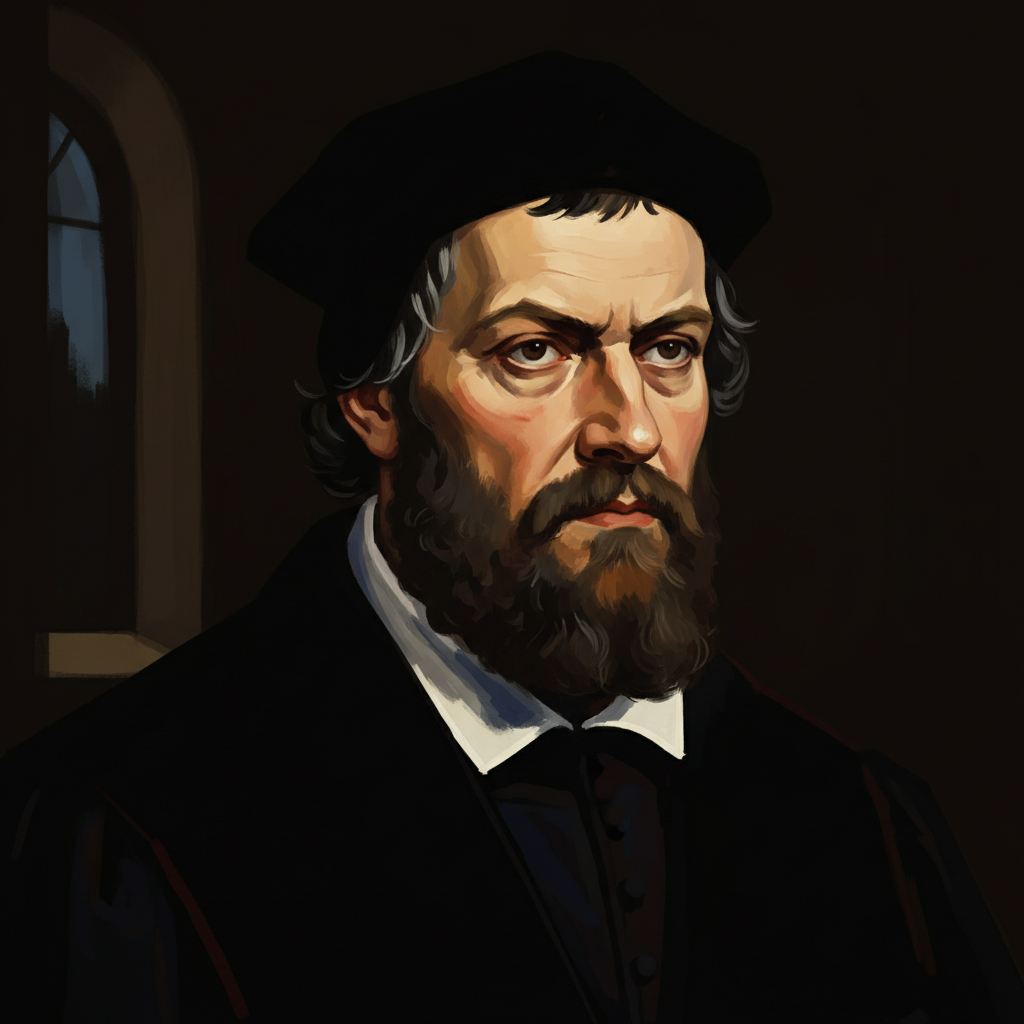
Martin Luther — "My conscience is captive to the Word of God."
My conscience is captive to the Word of God.
My conscience is captive to the Word of God.
Click any product to generate a realistic preview. Up to 3 at a time.
* Initial load can take up to 90 seconds — revising the preview in another color is nearly instant.
"So when the devil throws your sins in your face and declares that you deserve death and hell, tell him this: 'I admit that I deserve death and hell, what of it? For I know One who suffered and made sa…"
"The Bible is the cradle wherein Christ is laid."
"The assembly of his greased and religious crew in praying was altogether like the croaking of frogs, which edified nothing at all."
"Faith is permitting ourselves to be seized by the things we do not see."
"You Mr pope. are a brothel keeper. and the devil's daughter in hell."
German theologian whose 95 Theses (1517) launched the Protestant Reformation and broke the Catholic Church's monopoly on Western Christianity. Closely associated with Philipp Melanchthon (Lutheran systematizer) and John Calvin (later Reformer who built on Luther's break). For an intellectual contrast, see Pope Leo X, Renaissance pope (1513-1521) — Leo X's indulgence sales triggered Luther's break and Leo excommunicated him in 1521 — Luther's entire Reformation is structured as a direct answer to the indulgence-funded Vatican Leo represented.
Found in 1 providers: grok
1 source checked
Luther is saying his moral judgment is bound and owned by Scripture, not by any human authority. He cannot act against what the Bible plainly teaches, because doing so would violate his deepest convictions. Even under threat, he refuses to recant unless shown from Scripture that he is wrong. Conscience, for him, is not free-floating opinion but something answerable to a higher written standard he considers absolutely binding.
Luther spoke these words at the 1521 Diet of Worms when ordered to retract his writings before Emperor Charles V. A former Augustinian monk and theology professor at Wittenberg, he had built his reform on sola scriptura, the idea that Scripture alone governs Christian belief. Refusing to recant risked execution as a heretic, yet his entire career rested on submitting conscience only to the Bible, not popes or councils.
In early modern Europe, the Catholic Church and Holy Roman Empire fused religious and political authority, and defying either was treason and heresy. The printing press was spreading Luther's 95 Theses across Germany, fueling the Protestant Reformation. Kings, princes, and peasants were choosing sides, triggering decades of religious war. A single monk publicly placing Scripture above pope and emperor was revolutionary, shattering the medieval assumption that institutional church authority defined truth.
AI-generated insights based on extensive research and information for context. Factual errors? Email [email protected].
Your cart is empty