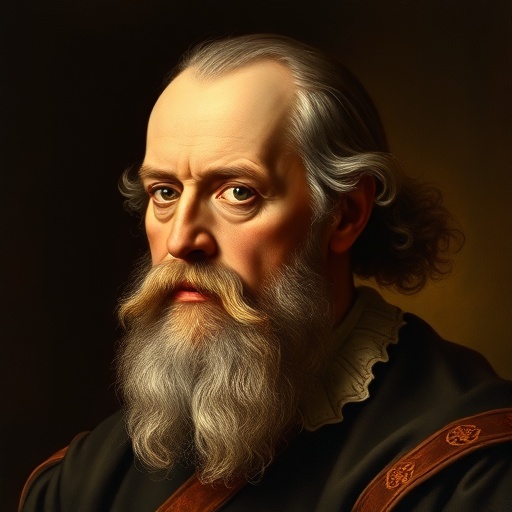
Galileo Galilei — "The more I study nature, the more I stand amazed at the work of the Creator."
The more I study nature, the more I stand amazed at the work of the Creator.
The more I study nature, the more I stand amazed at the work of the Creator.
Click any product to generate a realistic preview. Up to 3 at a time.
* Initial load can take up to 90 seconds — revising the preview in another color is nearly instant.
"To deny the principles of philosophy is to reject reason itself."
"Facts which at first seem improbable will, even on scant explanation, drop the cloak which has hidden them and stand forth in naked and simple beauty."
"It is a beautiful and admirable thing to know how to demonstrate the truth."
"It is a beautiful thing to know that the heavens are not immutable."
"In questions of science, the authority of a thousand is not worth the humble reasoning of a single individual."
A statement often attributed to him, reflecting his religious faith alongside his scientific pursuits.
Date: c. 1600s
Food & DrinkFound in 1 providers: grok
1 source checked
Deeper scientific investigation doesn't diminish wonder — it amplifies it. Learning how the natural world actually works makes it more astonishing, not less. Science and faith aren't opposites here; understanding nature's mechanics reveals something magnificent. Inquiry becomes an act of reverence. Knowledge breeds awe rather than stripping away mystery, suggesting that the universe rewards curiosity with a deeper sense of the extraordinary.
Galileo used his telescope to reveal moons orbiting Jupiter, craters on the Moon, and phases of Venus — observations that upended Aristotelian cosmology. Despite his conflict with the Church over heliocentrism, Galileo remained a man of faith who saw no contradiction between science and God. His life embodied this tension: prosecuted by the Inquisition yet personally devout, believing mathematics was the language God used to write the universe.
The early 17th century was a battleground between emerging empirical science and the authority of the Catholic Church, which held Earth as the immovable center of creation. Copernicus had proposed heliocentrism decades earlier but it remained deeply controversial. In this climate, professing awe at the Creator while pursuing radical telescopic discoveries was both genuine and politically necessary — a way to assert that observation and faith could coexist.
AI-generated insights based on extensive research and information for context. Factual errors? Email [email protected].
Your cart is empty