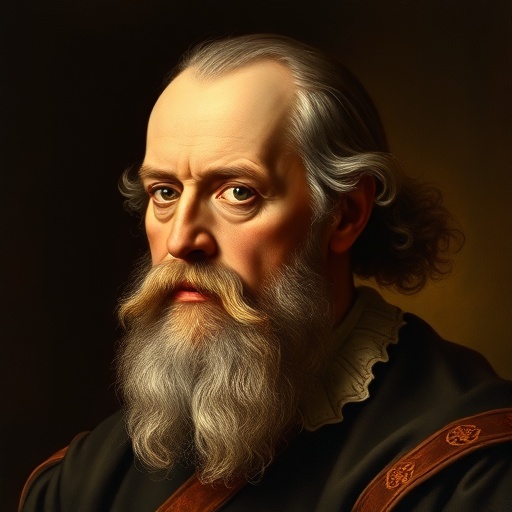
Galileo Galilei — "There are those who are so afraid of truth that they would rather deny the evide…"
There are those who are so afraid of truth that they would rather deny the evidence of their own senses than admit it.
There are those who are so afraid of truth that they would rather deny the evidence of their own senses than admit it.
Click any product to generate a realistic preview. Up to 3 at a time.
* Initial load can take up to 90 seconds — revising the preview in another color is nearly instant.
"To apply oneself to a search for the truth, without any intent to serve some predetermined end, is the true path to discovery."
"Where the senses fail us, reason must step in."
"Ignorance is the parent of fear."
"By denying scientific principles, one may maintain any paradox."
"The book of nature is a book of a single language, the language of mathematics."
Found in 1 providers: grok
1 source checked
Some people, when confronted with clear observable evidence that contradicts what they believe, choose to reject what they can plainly see rather than accept an uncomfortable truth. It describes willful ignorance driven by fear — cognitive dissonance in action. Empirical reality becomes secondary to protecting existing beliefs, comforts, or identities. The quote argues that the greatest obstacle to truth is not ignorance but the deliberate refusal to acknowledge what is right in front of you.
Galileo built his scientific method on direct telescopic observation — watching Jupiter's moons orbit it proved not everything revolved around Earth. When he invited Church officials to look through his telescope, some reportedly dismissed or refused the evidence entirely. His 1633 Inquisition trial and forced recantation of heliocentrism were the defining personal experience of this quote: powerful institutions choosing denial over what careful observation had made undeniable. He didn't theorize this phenomenon abstractly; he suffered it.
The early modern period saw the Scientific Revolution collide directly with fifteen centuries of Church-sanctioned Ptolemaic cosmology. Heliocentrism threatened not just astronomy but theology, scripture's authority, and the entire institutional structure of the Catholic Church. The Inquisition existed partly to enforce doctrinal conformity. Copernicus had proposed heliocentrism in 1543 but died before facing consequences. By Galileo's era, accepting new empirical evidence meant dismantling frameworks entire civilizations were built upon, making institutional denial a rational act of self-preservation.
AI-generated insights based on extensive research and information for context. Factual errors? Email [email protected].
Your cart is empty