Marie Curie — "My husband and I were so closely united by our affection and our common work tha…"
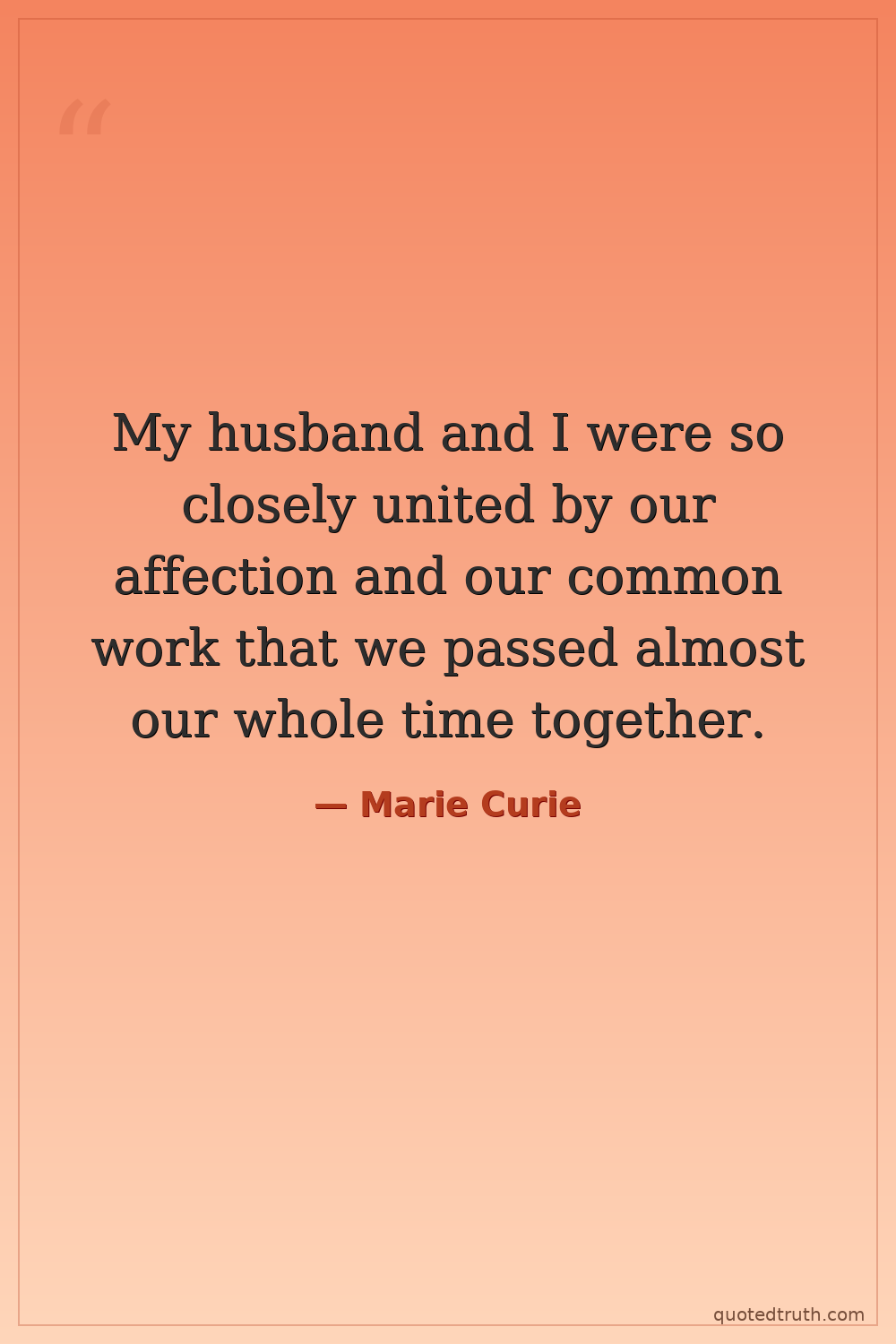
My husband and I were so closely united by our affection and our common work that we passed almost our whole time together.
My husband and I were so closely united by our affection and our common work that we passed almost our whole time together.
Click any product to generate a realistic preview. Up to 3 at a time.
* Initial load can take up to 90 seconds — revising the preview in another color is nearly instant.
"After all, science is essentially an international thing."
"I did not come to France to make money. I came to France to study science."
"I never saw myself as a woman in science. I saw myself as a scientist. And I am proud of it."
"I am a woman of science. I am a woman of reason. I am a woman of logic. I am a woman of truth. I am a woman of justice. I am a woman of peace. I am a woman of love. I am a woman of humanity. I am all …"
"I am not afraid of anything. I am only afraid of not being able to do my work. I am only afraid of not being able to discover new things. I am only afraid of not being able to contribute to the progre…"
Found in 1 providers: grok
1 source checked
Curie describes a marriage where love and professional partnership blurred into a single life. She and her husband spent nearly every hour together because they shared both deep affection and the same research. The quote captures how work and devotion reinforced each other rather than competing, making their bond unusually complete. It reflects a relationship defined by collaboration, not just companionship, where personal and professional lives were fully intertwined.
Marie and Pierre Curie worked side by side in a cramped Paris shed isolating radium, sharing the 1903 Nobel Prize in Physics. They co-authored papers, ground pitchblende together, and raised two daughters between experiments. Pierre's sudden death in 1906 devastated her, yet she continued their research and won a second Nobel in 1911. This quote mirrors that fused existence—her scientific breakthroughs were inseparable from the partnership that produced them.
In the late 19th and early 20th centuries, married women were largely barred from laboratories, universities, and professional science. The Curies' equal partnership was radical: most male scientists had wives confined to domestic roles, not co-investigators. France only granted women the right to vote in 1944, long after Marie's major discoveries. Her public acknowledgment of Pierre as a genuine scientific partner challenged assumptions about gender, marriage, and intellectual capability during a deeply patriarchal scientific establishment.
AI-generated insights based on extensive research and information for context. Factual errors? Email [email protected].
Your cart is empty