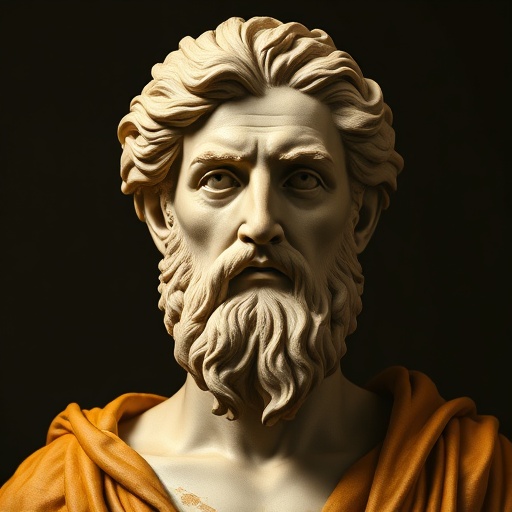
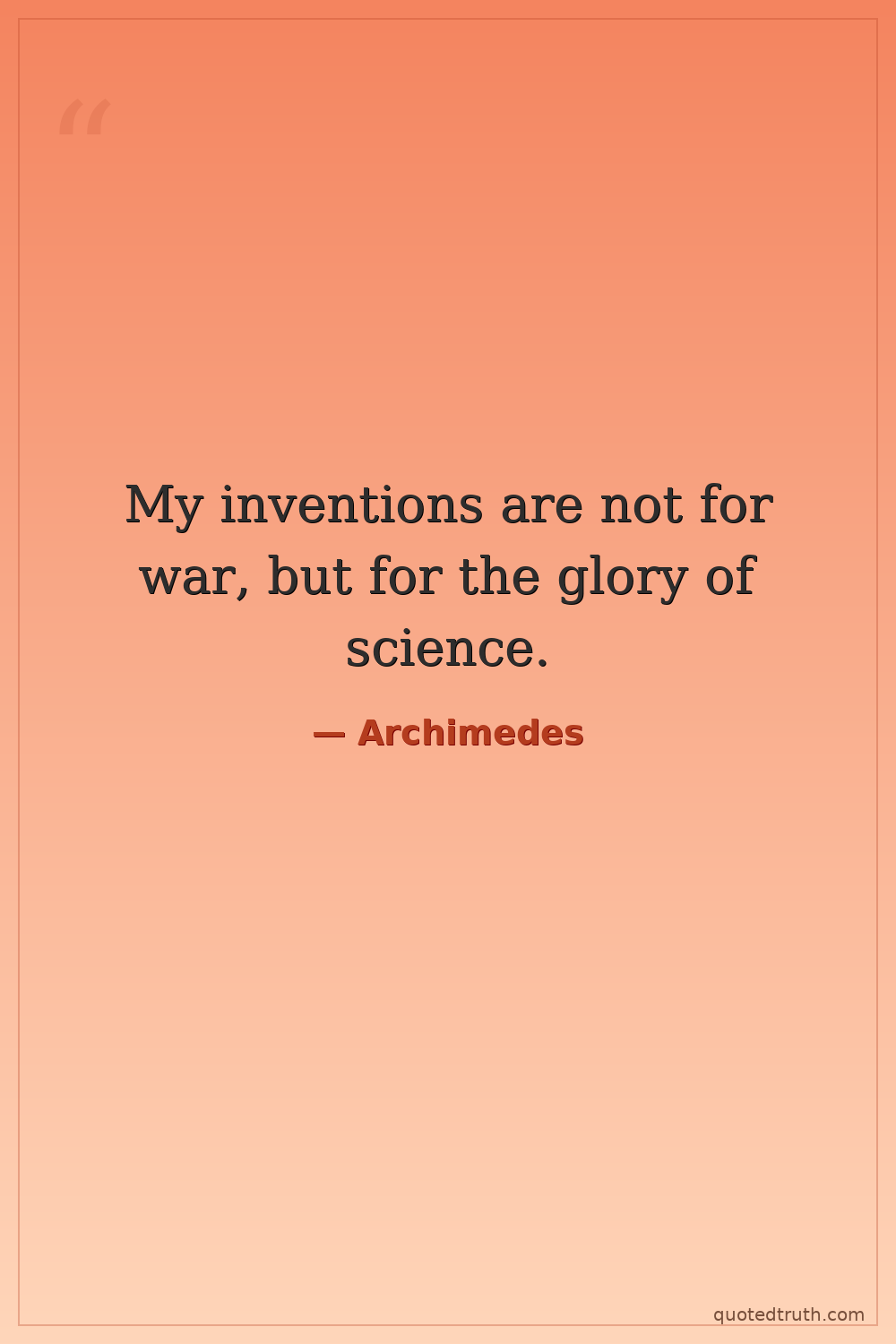
Archimedes — "My inventions are not for war, but for the glory of science."
My inventions are not for war, but for the glory of science.
My inventions are not for war, but for the glory of science.
Click any product to generate a realistic preview. Up to 3 at a time.
* Initial load can take up to 90 seconds — revising the preview in another color is nearly instant.
"By a method of mechanical reasoning, I first discovered that the area of a segment of a parabola is four-thirds of the triangle with the same base and equal height."
"He who understands the world well will not find it difficult to understand the laws that govern it."
"No difficulty can be too great for the human mind, if it applies itself with diligence and skill."
"Eureka!"
"The center of gravity of any triangle is the point of intersection of its medians."
A somewhat idealized view, given his military inventions for Syracuse.
Date: c. 250 BCE
GeneralFound in 1 providers: grok
1 source checked
The quote declares that knowledge-seeking, not destruction, drives invention. True scientific work aims to expand human understanding — not to serve armies or political agendas. Archimedes insists his creations belong to the world of ideas and discovery, regardless of how others might weaponize them. It is a claim of intellectual integrity: the purpose behind an invention is defined by its creator's intent, not its eventual use.
Archimedes designed war machines — cranes, catapults, and the famous Claw — to defend Syracuse from Roman siege around 214 BC, yet his deepest pride lay in pure mathematics. He requested geometric diagrams carved on his tomb, not war devices. He reportedly died mid-problem when Roman soldiers breached the city. His true passion was calculating pi, proving sphere-cylinder ratios, and discovering displacement principles — science pursued entirely for its own sake.
Archimedes lived during the Hellenistic period (287–212 BC), when Greek city-states faced Roman expansion and Carthaginian power. The Second Punic War engulfed the Mediterranean, forcing Syracuse to choose sides. Yet this same era was a golden age for Greek science — the Library of Alexandria flourished, Euclid formalized geometry, and philosopher-scientists were celebrated by rulers. Science and military necessity coexisted in uneasy tension, making his distinction between glory and warfare sharply pointed.
AI-generated insights based on extensive research and information for context. Factual errors? Email [email protected].
Your cart is empty