What it means
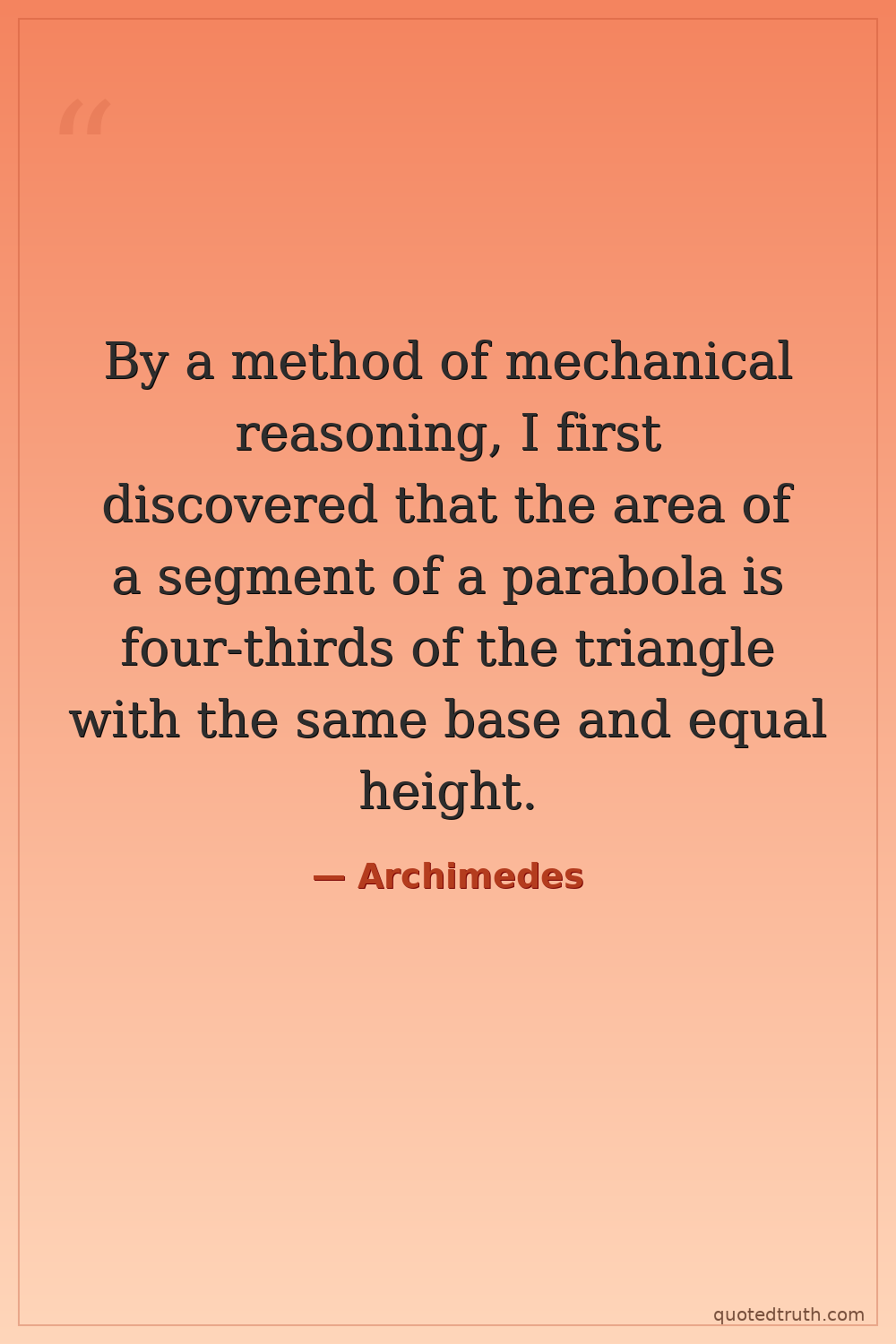
Physical intuition can unlock mathematical truth before formal proof exists. Archimedes treated geometric shapes as if they had physical weight, balancing them on an imaginary lever to discover that a curved parabolic region contains exactly four-thirds the area of the largest triangle fitting inside it. This mechanical method delivered the answer first; rigorous geometric proof came afterward. The insight separates discovery from verification — two distinct intellectual acts.
Relevance to Archimedes
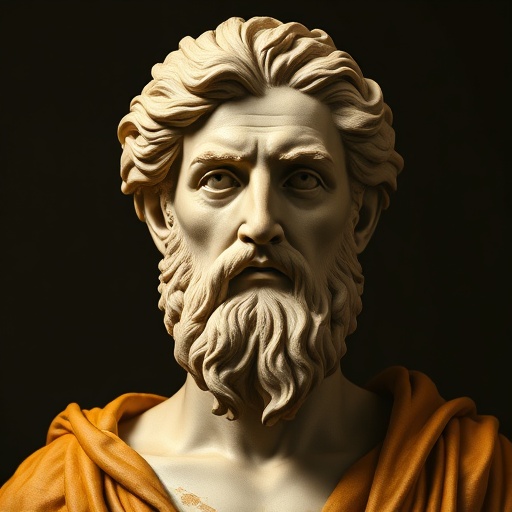
Archimedes of Syracuse was history's foremost ancient scientist — the man who estimated pi, formalized lever principles, and engineered war machines for Syracuse. This quote reveals his signature habit: using physical intuition as a scaffold for mathematics. His treatise "The Method," lost for centuries and rediscovered inside a Byzantine prayer book in 1906, describes this exact technique — mechanical reasoning as the discovery engine, with formal proof reserved for the finishing step.
The era
In 3rd-century BC Greek mathematics, conic sections were newly systematized by Apollonius, and Euclid's tradition demanded proof by geometric exhaustion — no calculus existed. Archimedes worked in Hellenistic Syracuse, culturally connected to Alexandria's great library, pushing geometry's absolute frontier. Determining a curved area without calculus required profound ingenuity. His mechanical analogy anticipated integral calculus by nearly 2,000 years, emerging in an era that accepted only pure logical deduction as legitimate mathematical reasoning.
AI-generated insights based on extensive research and information for context. Factual errors? Email [email protected].