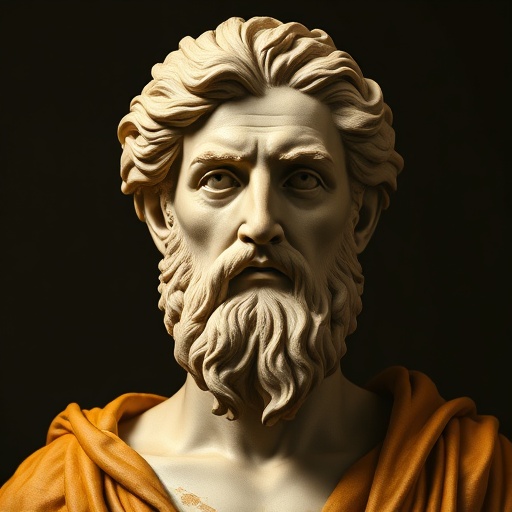
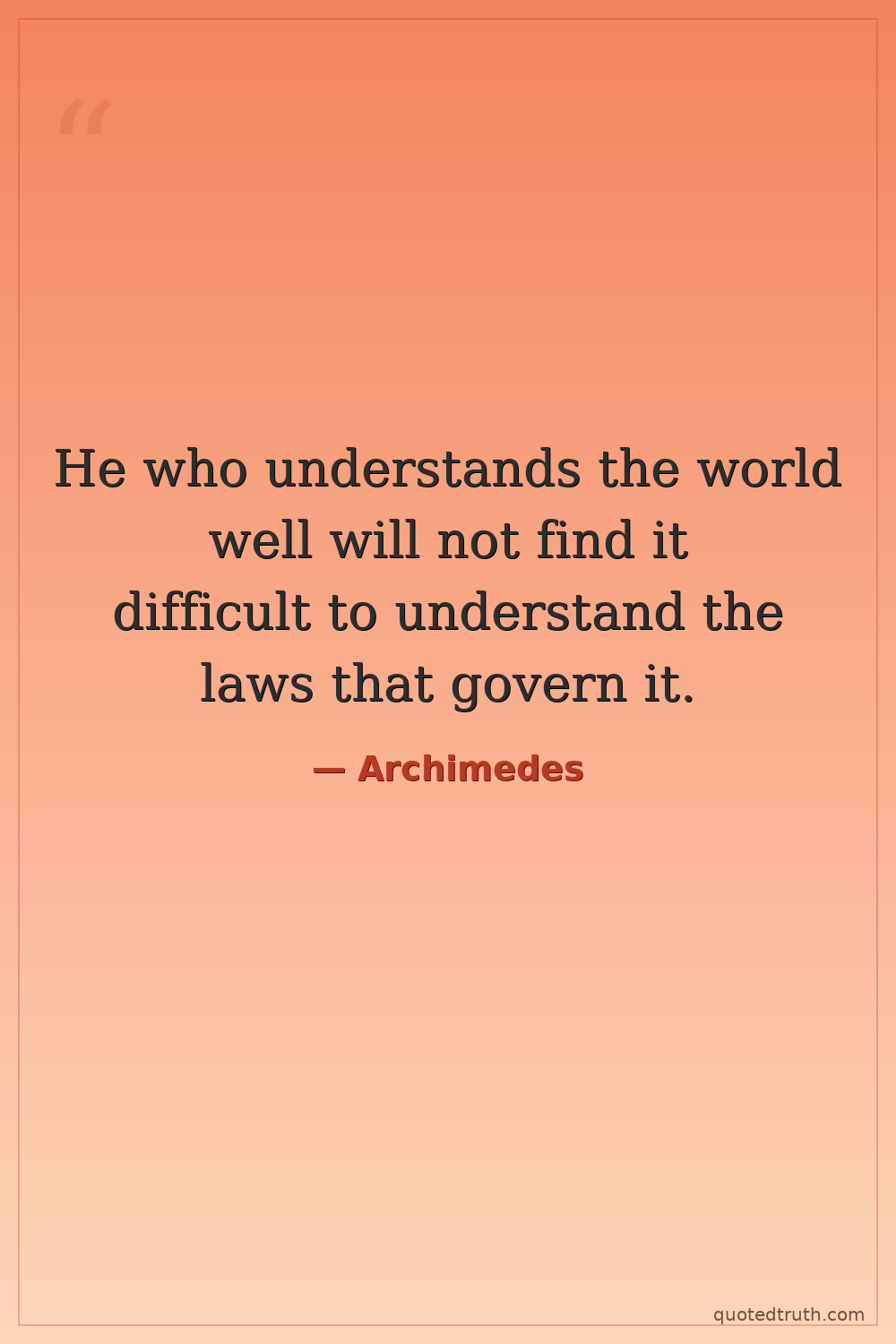
Archimedes — "He who understands the world well will not find it difficult to understand the l…"
He who understands the world well will not find it difficult to understand the laws that govern it.
He who understands the world well will not find it difficult to understand the laws that govern it.
Click any product to generate a realistic preview. Up to 3 at a time.
* Initial load can take up to 90 seconds — revising the preview in another color is nearly instant.
"The center of gravity of any triangle is the point of intersection of its medians."
"The area of a circle is equal to the area of a right-angled triangle whose sides containing the right angle are equal to the radius and circumference of the circle respectively."
"If I had a place to stand on, I could move the whole world."
"The properties of bodies depend on their figures."
"The cone is one third of the cylinder on the same base and of the same height."
Found in 1 providers: grok
1 source checked
Deep, genuine understanding of the natural world makes its governing principles feel inevitable rather than mysterious. If you truly observe how things behave and why, the underlying rules become clear on their own. Knowledge compounds — comprehension breeds more comprehension. Real understanding isn't memorizing formulas; it's developing intuition through close, honest engagement with reality until abstract laws feel obvious and self-evident.
Archimedes spent his life extracting mathematical laws from physical observation. His eureka moment — noticing water displacement in his bath — became the principle of buoyancy. He derived the law of the lever through hands-on mechanics, then deployed it to defend Syracuse with war machines. For Archimedes, understanding the world was never purely abstract; immersive engagement with physical reality was the direct path to universal law.
Archimedes lived in 3rd-century BC Syracuse during the Hellenistic period, when Greek thinkers were shifting from myth-based explanations to rational inquiry. Euclid had just systematized geometry; Eratosthenes would soon measure Earth's circumference. Yet most people still attributed natural phenomena to divine will. This statement captures a defining Hellenistic ambition: that patient, systematic observation of the physical world could yield universal laws legible to human reason alone.
AI-generated insights based on extensive research and information for context. Factual errors? Email [email protected].
Your cart is empty