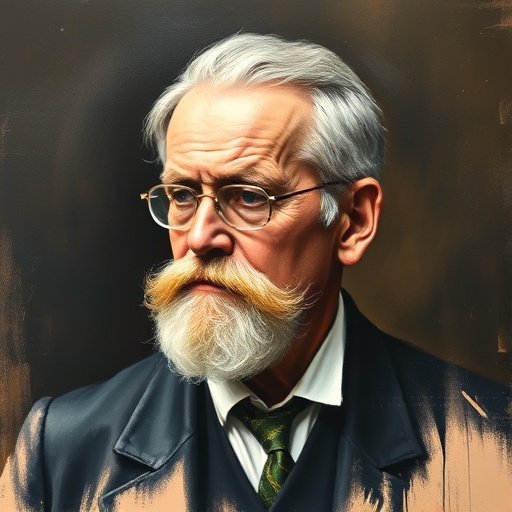
Gregor Mendel — "The value of the experiment as a means of solving questions of evolution must no…"
The value of the experiment as a means of solving questions of evolution must not be underestimated.
The value of the experiment as a means of solving questions of evolution must not be underestimated.
Click any product to generate a realistic preview. Up to 3 at a time.
* Initial load can take up to 90 seconds — revising the preview in another color is nearly instant.
"I hope that my experiments will furnish a new basis for the study of the history of the organic forms."
"I am convinced that it will not be long before the whole world acknowledges the results of my work."
"Jesus let the infidels and Jews aside, he appeared only to the chosen apostles, he was concerned only with the faithful believers. To these he taught, rebuked, and sanctified, in order to perfect them…"
"My scientific studies have afforded me great satisfaction; and I am convinced that it will not be long before the whole world acknowledges the results of my work."
"The characters of the two parental forms are transmitted to the hybrid in an unchanged form."
Found in 1 providers: grok
1 source checked
Controlled experiments are essential tools for understanding how life changes across generations. Pure observation or philosophical reasoning cannot substitute for systematic, hands-on testing when answering questions about biological inheritance and change. If we want real answers about why organisms vary and how traits pass down, we must design careful experiments and let the results speak — evidence, not assumption, drives genuine scientific progress.
Mendel spent eight years cross-breeding pea plants in his monastery garden, conducting thousands of controlled experiments that revealed the laws of inheritance. As an Augustinian friar without a university post, he understood that only rigorous experimentation could make his ideas credible. His methodical counting and statistical analysis of trait ratios — the very foundation of genetics — embodied his conviction that experiment, not intuition, unlocks biological truth.
Mendel worked in the 1850s–1860s, when Darwin's theory of evolution had ignited fierce debate about how traits were inherited and species changed over time. Natural selection needed a mechanism — something explaining what passed between generations — but none existed yet. Mendel's experimental framework, though ignored until 1900, was precisely the empirical bridge Darwin's theory lacked, making controlled biological experimentation the urgent intellectual frontier of mid-19th-century science.
AI-generated insights based on extensive research and information for context. Factual errors? Email [email protected].
Your cart is empty