Werner Heisenberg — "Natural science does not simply describe and explain nature; it is part of the i…"
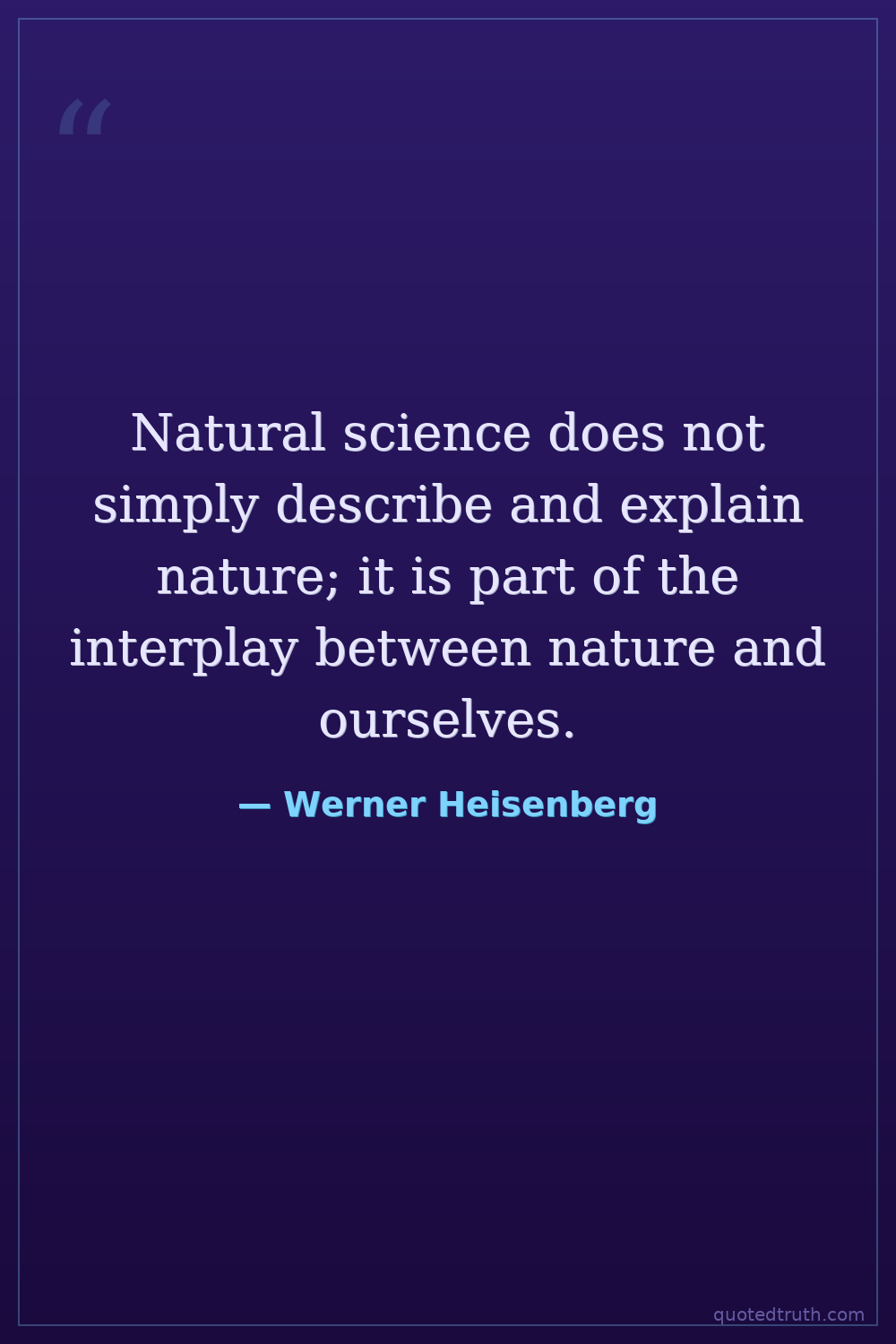
Natural science does not simply describe and explain nature; it is part of the interplay between nature and ourselves.
Natural science does not simply describe and explain nature; it is part of the interplay between nature and ourselves.
Click any product to generate a realistic preview. Up to 3 at a time.
* Initial load can take up to 90 seconds — revising the preview in another color is nearly instant.
"The world is not composed of 'things' but of 'events'."
"The very act of observing changes the observed."
"Modern physics has, in a certain sense, revived Plato's philosophy of forms in the atomic world."
"The first gulp from the glass of natural sciences will turn you into an atheist, but at the bottom of the glass God is waiting for you."
"It is not surprising that our language should be incapable of describing the processes occurring within the atoms, for, as has been remarked, it was invented to describe the experiences of daily life,…"
Emphasizing the subjective element in science
Date: 1955 (Physics and Philosophy)
EducationalFound in 1 providers: grok
1 source checked
Science is not a neutral mirror held up to reality. When we observe and measure the world, we are already participating in it, shaping what we find by the questions we ask and the tools we use. Knowledge emerges from a two-way exchange: nature responds to how we probe it, and our understanding reflects both what is there and the human perspective doing the looking. Objectivity has limits.
Heisenberg formulated the uncertainty principle, proving that measuring a particle's position disturbs its momentum, and vice versa. The observer cannot be cleanly separated from the observed. As a founder of quantum mechanics, he watched classical certainty collapse and spent decades defending a philosophical reading of physics in which human questions partly construct the answers. This quote distills the worldview his equations forced on him.
Writing in the mid-twentieth century, Heisenberg lived through the quantum revolution, two world wars, and the atomic age he helped enable. Newtonian determinism had crumbled, Einstein's relativity had bent space and time, and nuclear weapons made clear that inquiry into nature reshapes civilization. Philosophers and physicists alike were reexamining what science could truthfully claim. His statement captured a hard-won humility about knowledge that defined modern thought.
AI-generated insights based on extensive research and information for context. Factual errors? Email [email protected].
Your cart is empty