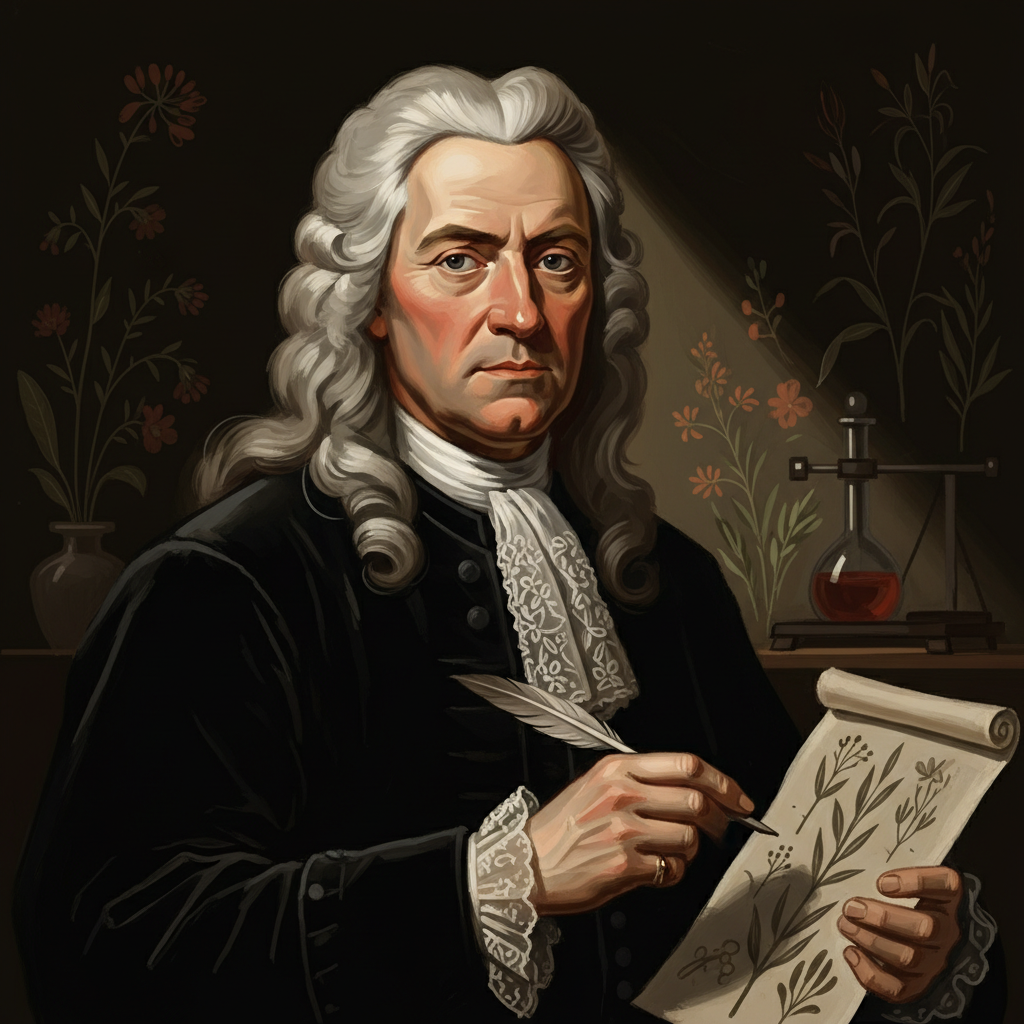
Carl Linnaeus — "Nature has always been my school, and my teachers have been the trees, the flowe…"
Nature has always been my school, and my teachers have been the trees, the flowers, and the stones.
Nature has always been my school, and my teachers have been the trees, the flowers, and the stones.
Click any product to generate a realistic preview. Up to 3 at a time.
* Initial load can take up to 90 seconds — revising the preview in another color is nearly instant.
"Homo sapiens, nosce te ipsum. (Man, know thyself.)"
"A plant is a living being, but it cannot feel."
"Women are more lascivious than men, as is evident from their greater lubricity and their monthly purgations."
"The Earth's Creation is the glory of God, as seen from the works of Nature by Man alone."
"In natural science the principles of truth ought to be confirmed by observation."
Swedish botanist and the father of modern taxonomy whose Systema Naturae (1735) introduced binomial nomenclature for naming all species. Closely associated with Joseph Banks (British naturalist who carried Linnaean classification on Cook's voyages). For an intellectual contrast, see Comte de Buffon, French naturalist and Histoire Naturelle author (1749-1788) — Buffon explicitly attacked Linnaean fixed-categories taxonomy as artificial and rejected the binomial system; his gradualist, environment-shaped natural history was the explicit alternative. Anticipates the fixed-species-vs-evolution debate Darwin would later resolve.
A poetic reflection on his source of knowledge and inspiration.
Date: Uncertain (attributed)
EducationalFound in 1 providers: gemini
1 source checked
Knowledge comes from direct observation of the natural world, not from books or institutions alone. The physical environment itself teaches those willing to pay attention. Trees, flowers, and stones carry information that formal education cannot fully replicate. Learning happens through immersion in nature, through touching, cataloging, and questioning what exists around you rather than accepting inherited dogma uncritically.
Linnaeus spent his youth exploring Swedish forests and fields, developing his passion for plants before any formal training. His revolutionary binomial nomenclature system emerged from obsessive hands-on observation of thousands of specimens. He led field expeditions throughout Lapland and Europe, believing classification required direct physical encounter with organisms. His Systema Naturae was built entirely on empirical observation, making this sentiment autobiographically precise.
The early modern period saw natural philosophy transitioning from classical authority toward empiricism. While universities still taught Aristotle and ancient texts, figures like Linnaeus helped pioneer systematic field observation. The Scientific Revolution had already shifted thinking, but natural history remained chaotic without standardized classification. Exploration voyages were revealing thousands of unknown species, creating urgent need for exactly the observational, nature-first methodology Linnaeus championed.
AI-generated insights based on extensive research and information for context. Factual errors? Email [email protected].
Your cart is empty