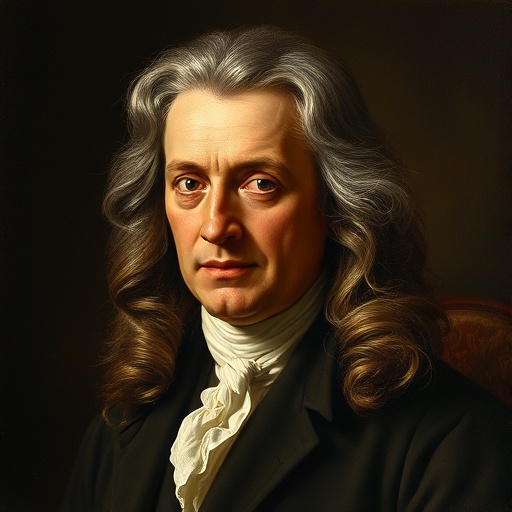
Isaac Newton — "Nature is pleased with simplicity."
Nature is pleased with simplicity.
Nature is pleased with simplicity.
Click any product to generate a realistic preview. Up to 3 at a time.
* Initial load can take up to 90 seconds — revising the preview in another color is nearly instant.
"I have a fundamental belief in the Bible as the Word of God, written by those who were inspired. I study the Bible daily."
"The changing of bodies into light, and light into bodies, is very conformable to the course of Nature."
"Gravity must be caused by some agent acting constantly according to certain laws; but whether this agent be material or immaterial, I have left to the consideration of my readers."
"If I have seen further than others, it is by standing upon the shoulders of giants."
"I do not know what I may appear to the world, but to myself I seem to have been only like a boy playing on the seashore, and diverting myself in now and then finding a smoother pebble or a prettier sh…"
Found in 1 providers: deepseek
1 source checked
The universe runs on elegant, minimal rules rather than complicated machinery. When explaining how things work, nature favors the simplest sufficient cause — no unnecessary layers, no superfluous mechanisms. A single equation governs both a falling apple and orbiting planets. This idea, aligned with Occam's Razor, argues that truth reveals itself through clarity, not complexity. Strip away the noise and simple principles explain vast phenomena — a conviction Newton embedded in his entire scientific method.
Newton proved this with his own work: three laws of motion reduced all mechanical behavior to concise rules; one gravitational equation unified terrestrial and celestial physics. He explicitly stated in Principia that he would not feign hypotheses beyond what observation demands. His faith reinforced the idea — God as perfect architect would build an ordered, economical cosmos. Complexity, for Newton, signaled human confusion, not nature's true design.
Newton wrote during the late Scientific Revolution, when natural philosophers were dismantling 1,500 years of Aristotelian complexity — epicycles, nested spheres, elaborate teleological causes. The old system needed ever more patches to explain observations; Newton's approach replaced all of it with elegant mathematics. The Reformation had similarly challenged intricate Church hierarchies. Simplicity was a deliberate intellectual rebellion: proof that God's creation, properly understood, needed no baroque scaffolding to explain.
AI-generated insights based on extensive research and information for context. Factual errors? Email [email protected].
Your cart is empty