What it means
Newton is saying gravity clearly operates through some consistent, rule-following mechanism or agent, but he deliberately refuses to declare whether that cause is physical matter or something metaphysical. He describes how gravity behaves with mathematical precision while explicitly declining to answer what ultimately produces it. Identify the pattern, calculate the effect, prove the law — but don't speculate beyond what evidence can demonstrate.
Relevance to Isaac Newton
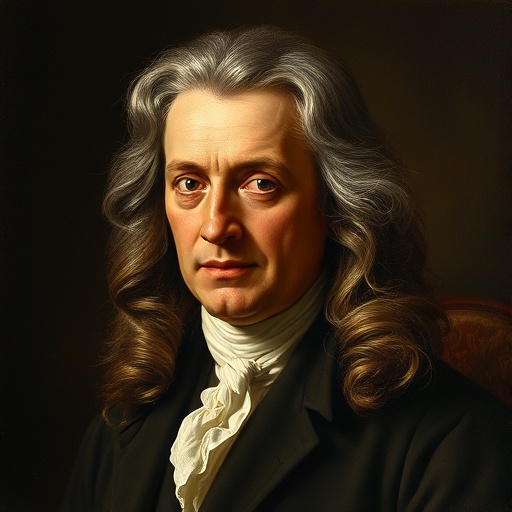
Newton coined 'Hypotheses non fingo' — I frame no hypotheses — as a methodological creed. Deeply religious, he spent more time writing theology than physics, viewing God as a plausible agent behind natural forces. Yet as a mathematician he demanded demonstrated proof over speculation. His Principia Mathematica delivered exact gravitational laws while he refused to commit on their metaphysical cause, perfectly embodying that lifelong tension.
The era
The 17th century saw natural philosophy straining to separate from theology. Descartes and Leibniz championed mechanical causation — everything required physical contact to explain it. Newton's action-at-a-distance gravity scandalized them; Leibniz called it an occult quality. Meanwhile the Church remained powerful, and linking God to natural law was intellectually serious, not just pious. Whether immaterial agents could drive physical phenomena was a live, urgent debate, not a rhetorical one.
AI-generated insights based on extensive research and information for context. Factual errors? Email [email protected].