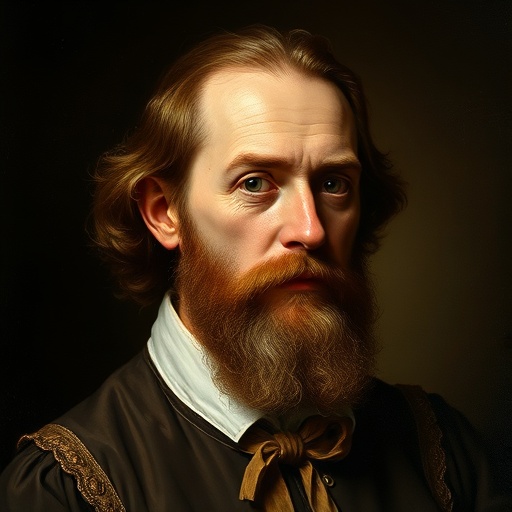
William Harvey — "Nature is the best teacher."
Nature is the best teacher.
Nature is the best teacher.
Click any product to generate a realistic preview. Up to 3 at a time.
* Initial load can take up to 90 seconds — revising the preview in another color is nearly instant.
"The blood carries nourishment to all parts of the body."
"It is better to know a little perfectly than to know much imperfectly."
"The heart is a muscle, and its function is to pump blood."
"The world is a living creature."
"The heart is a pump, and the blood is a fluid."
English physician whose On the Motion of the Heart and Blood in Animals (1628) demonstrated blood circulation, overturning 1,400 years of Galenic medicine. Closely associated with Francis Bacon (his contemporary in the new English empiricism). For an intellectual contrast, see Galenic medicine, the 2nd-century Greek medical tradition (humors, blood-as-consumed-fuel) — Harvey calculated that the heart pumps more blood per hour than the body could possibly produce as fuel — a single quantitative observation that demolished the entire Galenic-Aristotelian medical worldview. The cleanest example in medical history of arithmetic disproving 14 centuries of authority.
A concise statement on the importance of empirical study of nature.
Date: Uncertain (attributed)
EducationalFound in 1 providers: gemini
1 source checked
The natural world, observed directly and honestly, teaches us more than books or inherited doctrine ever could. Truth emerges from watching how things actually work, not from accepting what authorities claim. Careful observation of real phenomena reveals principles that no amount of theorizing or second-hand scholarship can match. Nature itself is the ultimate source of reliable knowledge.
Harvey embodied this conviction when he challenged Galen's 1,400-year-old theory of blood movement by dissecting animals, measuring heart output, and calculating that blood must circulate rather than be continuously produced. His 1628 De Motu Cordis was built entirely on direct experimental observation, not classical texts, making him a founding figure of empirical medicine.
The early 17th century was a battleground between scholastic reliance on Aristotle and Galen versus the emerging empiricist method championed by figures like Bacon and Vesalius. Harvey worked as Europe's universities still taught ancient authority as gospel. His insistence on anatomical experiment over inherited text was genuinely radical, helping shift Western science toward observation-based inquiry and away from reverence for ancient masters.
AI-generated insights based on extensive research and information for context. Factual errors? Email [email protected].
Your cart is empty