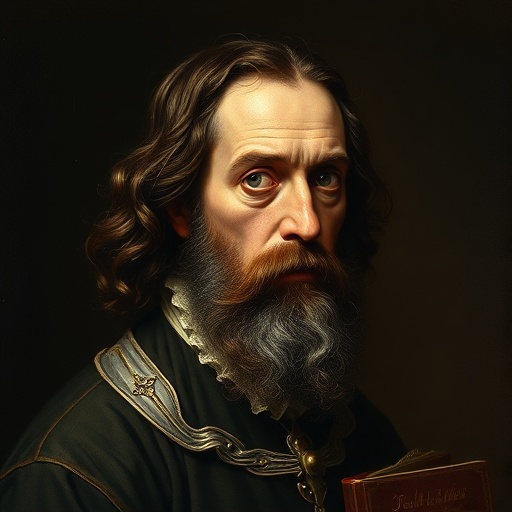
Johannes Kepler — "Nature uses as little as possible of anything."
Nature uses as little as possible of anything.
Nature uses as little as possible of anything.
Click any product to generate a realistic preview. Up to 3 at a time.
* Initial load can take up to 90 seconds — revising the preview in another color is nearly instant.
"I have been a philosopher, and I have pondered the meaning of life."
"The diversity of the phenomena of nature is so great, and the treasures hidden in the heavens so rich, precisely in order that the human mind shall never be lacking in fresh nourishment."
"I have been a father, and I have rejoiced in my children."
"Provide ship or sails adapted to the heavenly breezes, and there will be some who will not fear even that void [of space]… . So, for those who will come shortly to attempt this journey, let us establi…"
"I have a mind that is always seeking new things."
Found in 1 providers: deepseek
1 source checked
Nature operates with maximum efficiency, never wasting resources or effort. When nature produces a result, it does so through the simplest, most economical means available. Whether forming a crystal, orbit, or organism, the underlying process avoids excess. This is an early statement of what scientists later called the principle of parsimony or least action: given multiple possible paths, nature consistently selects the one requiring the smallest expenditure of material, energy, or complexity.
Kepler spent years fitting planetary orbits to observational data and repeatedly found that elegant, minimal geometric rules governed the heavens. His three laws replaced dozens of Ptolemaic epicycles with simple ellipses and proportional relationships. A devout Lutheran, he believed God designed the cosmos as a rational, harmonious system, so economy in nature confirmed divine craftsmanship. This conviction drove him to discard his own beautiful Platonic-solids model when Tycho Brahe's Mars data demanded simpler elliptical truth.
In the early 1600s, the Scientific Revolution was dismantling Aristotelian physics and Ptolemaic astronomy. Galileo's telescope, Brahe's precise measurements, and Kepler's mathematics were replacing qualitative philosophy with quantitative law. The Thirty Years' War raged, and the Catholic Church was prosecuting Galileo, yet natural philosophers across Protestant Europe pursued a mechanical, mathematical cosmos. The idea that nature follows minimal, rational principles foreshadowed Newton, Fermat's least-time optics, and Maupertuis's least-action principle a century later.
AI-generated insights based on extensive research and information for context. Factual errors? Email [email protected].
Your cart is empty