What it means
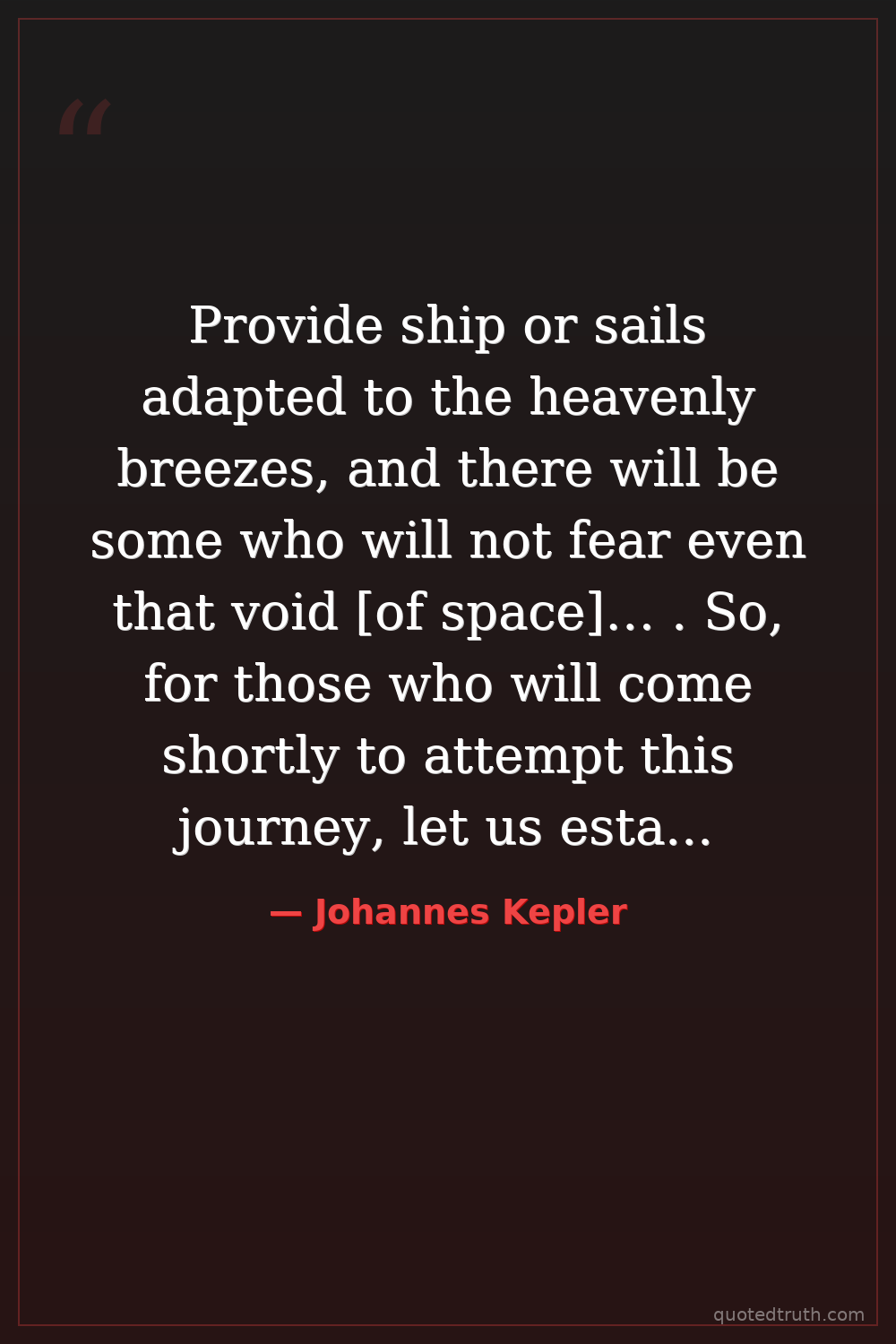
Kepler imagines building spacecraft suited to cosmic conditions, predicting that future explorers will brave the vacuum of space without fear. He urges himself and Galileo to prepare the scientific groundwork now so later travelers have star charts ready. He divides the work: Galileo should map Jupiter's system through his telescope, while Kepler will chart the Moon, giving tomorrow's voyagers a head start.
Relevance to Johannes Kepler
Kepler spent his life translating Tycho Brahe's observations into mathematical laws of orbital motion, and he wrote Somnium, a pioneering work of lunar science fiction imagining a trip to the Moon. His correspondence with Galileo defending the Copernican system, combined with his willingness to project human travel beyond Earth, shows the visionary imagination behind his rigorous geometry.
The era
The early 1600s saw Galileo's telescope reveal Jupiter's moons and lunar mountains, shattering Aristotelian cosmology. The Catholic Church was moving toward condemning heliocentrism, making Kepler's speculation bold. Europe was simultaneously in an age of maritime exploration, with Dutch and Portuguese ships charting new continents, so extending voyages to the heavens felt like a natural extrapolation of an expansionist, telescope-equipped scientific Europe.
AI-generated insights based on extensive research and information for context. Factual errors? Email [email protected].