What it means
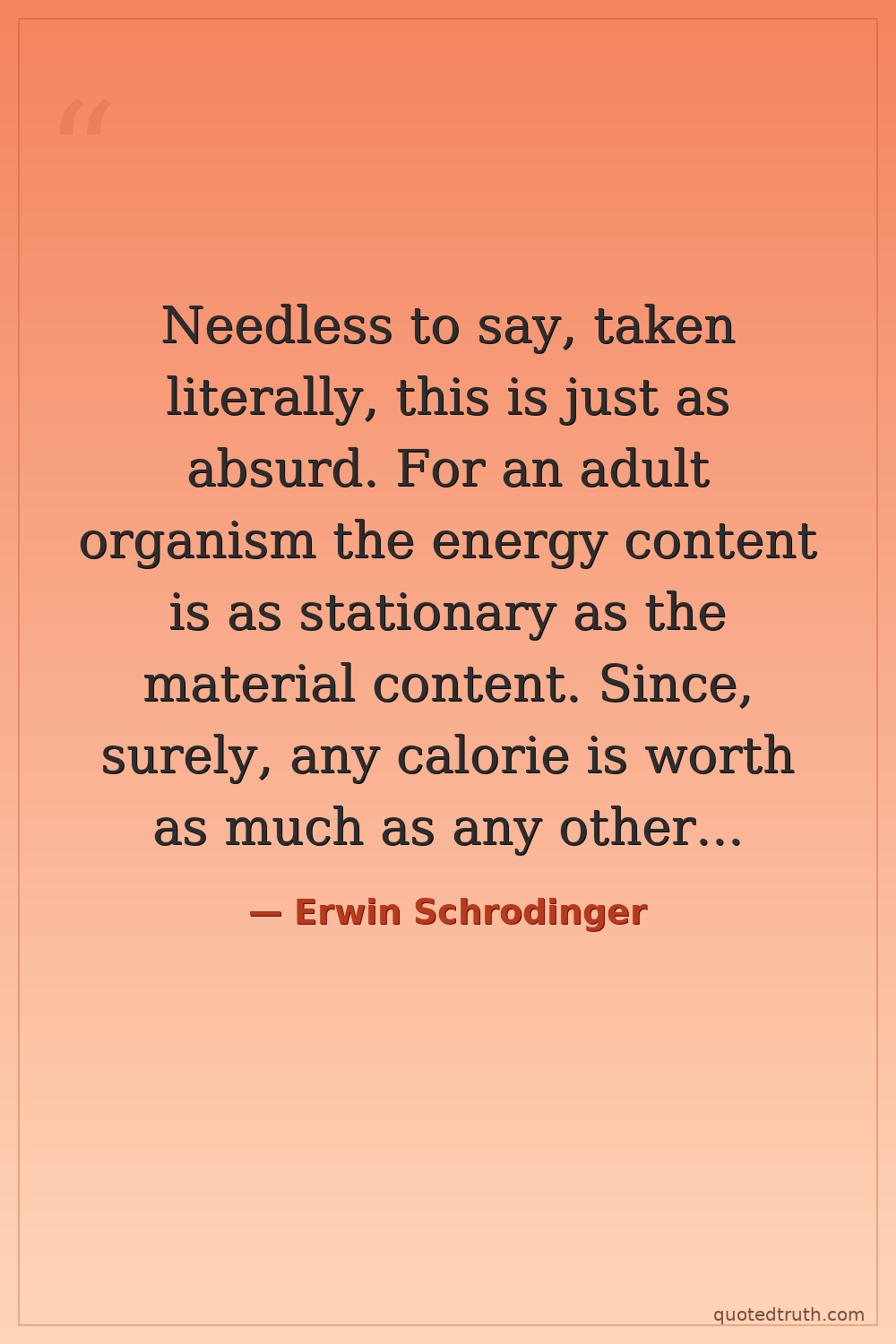
Living things don't stay alive simply by swapping energy in and out. In a mature organism, total energy stays roughly constant — and if every calorie is equivalent to every other, a simple exchange explains nothing. Schrödinger is tearing down a weak argument before making his real point: organisms must extract something more specific from their environment than raw energy — namely, structured order, or what he calls negative entropy.
Relevance to Erwin Schrodinger
From What is Life? (1944), written while Schrödinger sheltered in wartime Dublin after fleeing Nazi Europe. As the father of wave mechanics, he applied the same analytical discipline to biology: expose the flaw in the obvious explanation, then propose a deeper one. His conclusion — that life feeds on negative entropy — directly inspired Watson and Crick and helped birth molecular biology, showing a physicist's mind reshaping an entire field.
The era
Schrödinger lectured in Dublin in 1943, mid-World War II, when the physical basis of heredity was still mysterious and thermodynamics was just beginning to be applied to living systems. Quantum mechanics had already overturned classical physics; scientists now wondered whether similar precision could crack biology. Entropy — disorder versus order — was central to physics but rarely applied to life, making Schrödinger's move radical and timely, foreshadowing the DNA revolution a decade later.
AI-generated insights based on extensive research and information for context. Factual errors? Email [email protected].