What it means
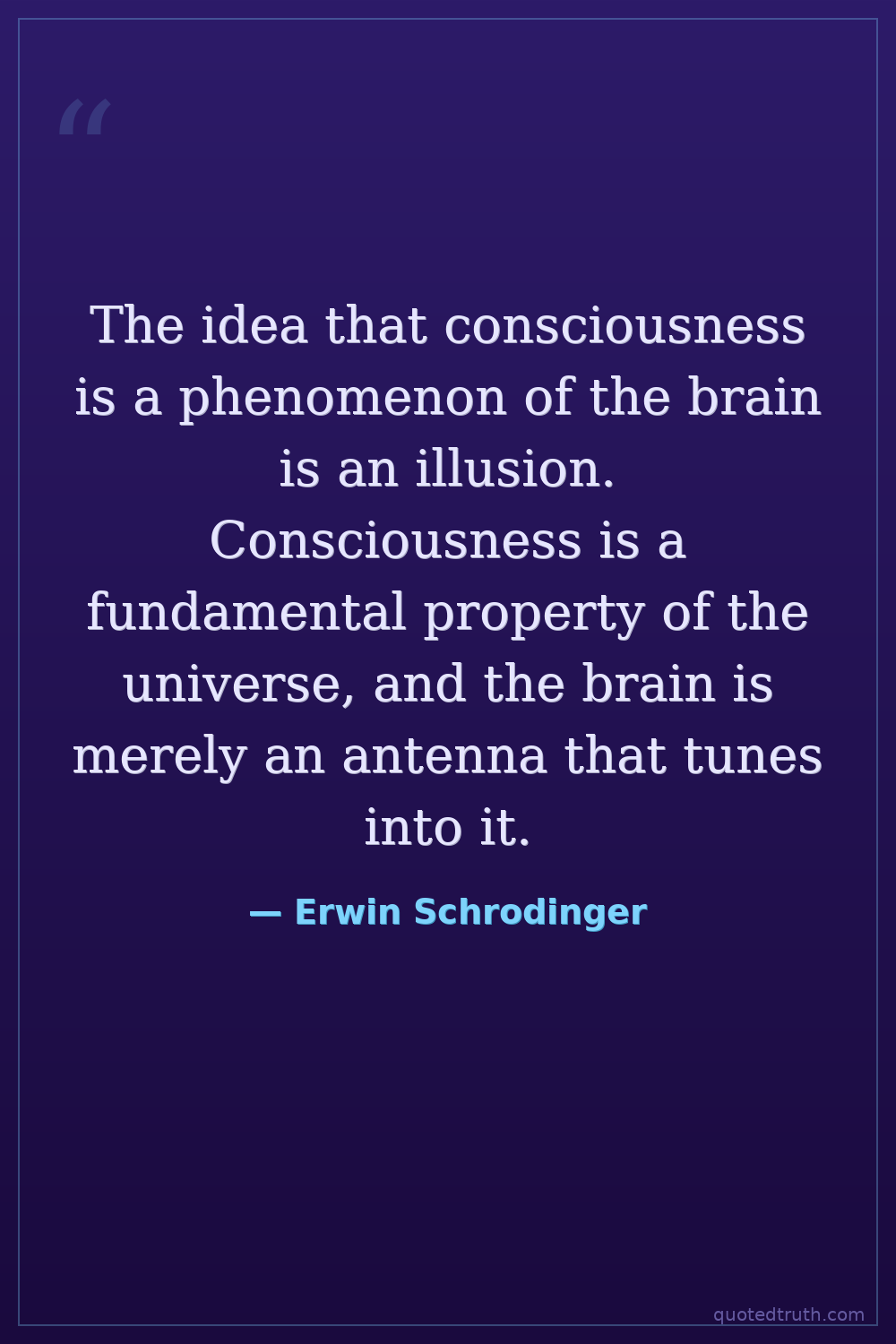
The quote argues that consciousness is not manufactured by the brain the way a factory produces goods. Instead, consciousness exists as a primary, irreducible feature of reality itself — built into the fabric of the universe. The brain's role is passive: a receiver, like a radio tuning into a signal that exists independently of the device. Destroy the radio and the signal remains; damage the brain and consciousness persists elsewhere.
Relevance to Erwin Schrodinger
Schrödinger genuinely wrestled with consciousness in 'What is Life?' (1944) and 'Mind and Matter' (1958). Deeply influenced by Hindu Vedanta, he wrote that 'consciousness is a singular of which the plural is unknown' — meaning one universal consciousness, not billions of private ones. His quantum work showed that observation affects physical reality, making the observer's mind scientifically non-trivial. This quote directly echoes his Vedantic belief in unified, fundamental awareness.
The era
Schrödinger worked during quantum mechanics' revolutionary emergence in the 1920s–1950s, when the observer's role in collapsing wave functions made consciousness scientifically unavoidable. Classical materialism — the brain-as-machine view — dominated Western science, yet Eastern philosophy was gaining Western intellectual traction. Against Cold War-era scientific reductionism, thinkers like Schrödinger pushed back, arguing physics itself demanded rethinking mind's relationship to matter at the universe's deepest level.
AI-generated insights based on extensive research and information for context. Factual errors? Email [email protected].