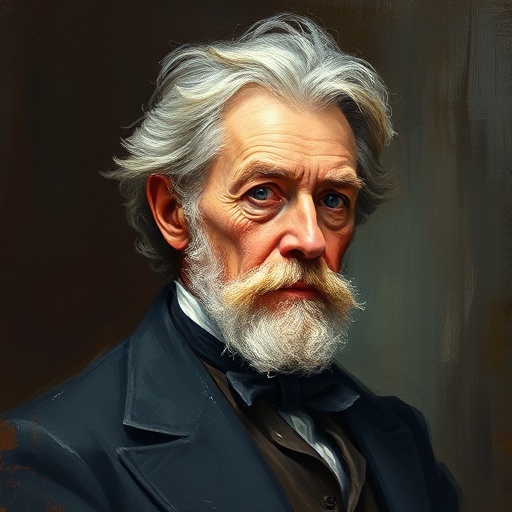
Michael Faraday — "Never be afraid to ask questions."
Never be afraid to ask questions.
Never be afraid to ask questions.
Click any product to generate a realistic preview. Up to 3 at a time.
* Initial load can take up to 90 seconds — revising the preview in another color is nearly instant.
"Nothing is too wonderful to be true, if it be consistent with the laws of nature; and in such things as these, experiment is the best test of consistency."
"There's nothing quite as frightening as someone who knows they are right."
"I am a firm believer in the power of observation and experimentation."
"It may be a weed instead of a fish that, after all my labour, I at last pull up."
"Magnetic curves are lines of force; they are not only lines of force but lines of action."
Attributed, a common piece of advice from scientists.
Date: Mid 19th Century (approx.)
WisdomFound in 1 providers: grok
1 source checked
Curiosity is not a weakness to hide but a tool to wield. Asking questions, even ones that seem basic or risk looking ignorant, is how genuine understanding begins. The advice pushes back against the fear of appearing foolish, arguing that silence protects ego while inquiry builds knowledge. Progress belongs to those willing to admit gaps and probe further rather than nod along and pretend to already know.
Faraday had almost no formal schooling, leaving school around age thirteen and apprenticing as a bookbinder. He built his scientific career by reading voraciously, attending Humphry Davy's lectures, and persistently asking to learn. His discovery of electromagnetic induction came from relentless experimental questioning of assumptions. For a self-taught outsider entering the Royal Institution, the willingness to ask what others took for granted was literally the engine of his rise.
Faraday worked in early-to-mid 1800s Britain, when science was transitioning from gentleman-amateur pursuit to professional discipline. The Royal Institution's public lectures democratized knowledge, yet class barriers kept working-class minds out of universities. Industrial Revolution machinery was outrunning theoretical understanding of electricity and chemistry. In this climate, encouraging ordinary people to question nature rather than defer to authority was quietly radical and aligned with the broader Victorian push toward self-education and mechanics' institutes.
AI-generated insights based on extensive research and information for context. Factual errors? Email [email protected].
Your cart is empty