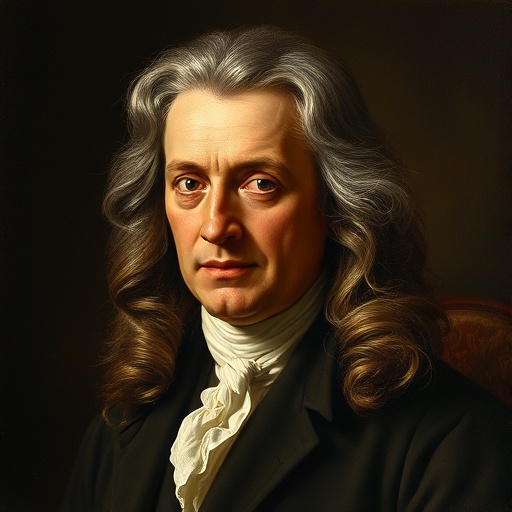
Isaac Newton — "No great discovery was ever made without a bold guess."
No great discovery was ever made without a bold guess.
No great discovery was ever made without a bold guess.
Click any product to generate a realistic preview. Up to 3 at a time.
* Initial load can take up to 90 seconds — revising the preview in another color is nearly instant.
"He that in the study of natural philosophy shall resolve to proceed upon nothing but demonstrations and sound knowledge, hath a very large field of materials of all sorts to divert and employ him."
"Tact is the art of making a point without making an enemy."
"The true way of considering a thing is by its causes."
"The changing of bodies into light, and light into bodies, is very conformable to the course of Nature."
"The motions which the planets now have could not spring from any natural cause alone, but were impressed by an intelligent Agent."
Found in 2 providers: grok,deepseek
2 sources checked
True breakthroughs don't come from playing it safe. Making a significant discovery requires someone to venture beyond known facts and propose an explanation that hasn't been proven yet. The bold guess — the hypothesis that seems audacious at the time — is what opens new territory. Caution and careful measurement matter, but they follow the initial leap of imagination that dares to claim something new about how the world works.
Newton's greatest insight — that the force pulling an apple downward is identical to the force keeping the Moon in orbit — was a staggering speculative leap, not an obvious extension of prior work. His invention of calculus, his corpuscular theory of light, and his universal law of gravitation all began as hypotheses far ahead of available proof. Newton embodied the willingness to stake a bold claim and then build the mathematics to support it.
Newton worked during the Scientific Revolution, when Europe was overthrowing fifteen centuries of Aristotelian dogma. The Royal Society, founded in 1660, championed empirical inquiry, but the era also demanded courage to theorize beyond data — Galileo had been condemned for less. Newton's peers, including Boyle, Hooke, and Leibniz, were racing to explain nature mathematically. Proposing one invisible force governing both terrestrial and celestial motion was genuinely radical thinking for the 1680s.
AI-generated insights based on extensive research and information for context. Factual errors? Email [email protected].
Your cart is empty