Isaac Newton — "The motions which the planets now have could not spring from any natural cause a…"
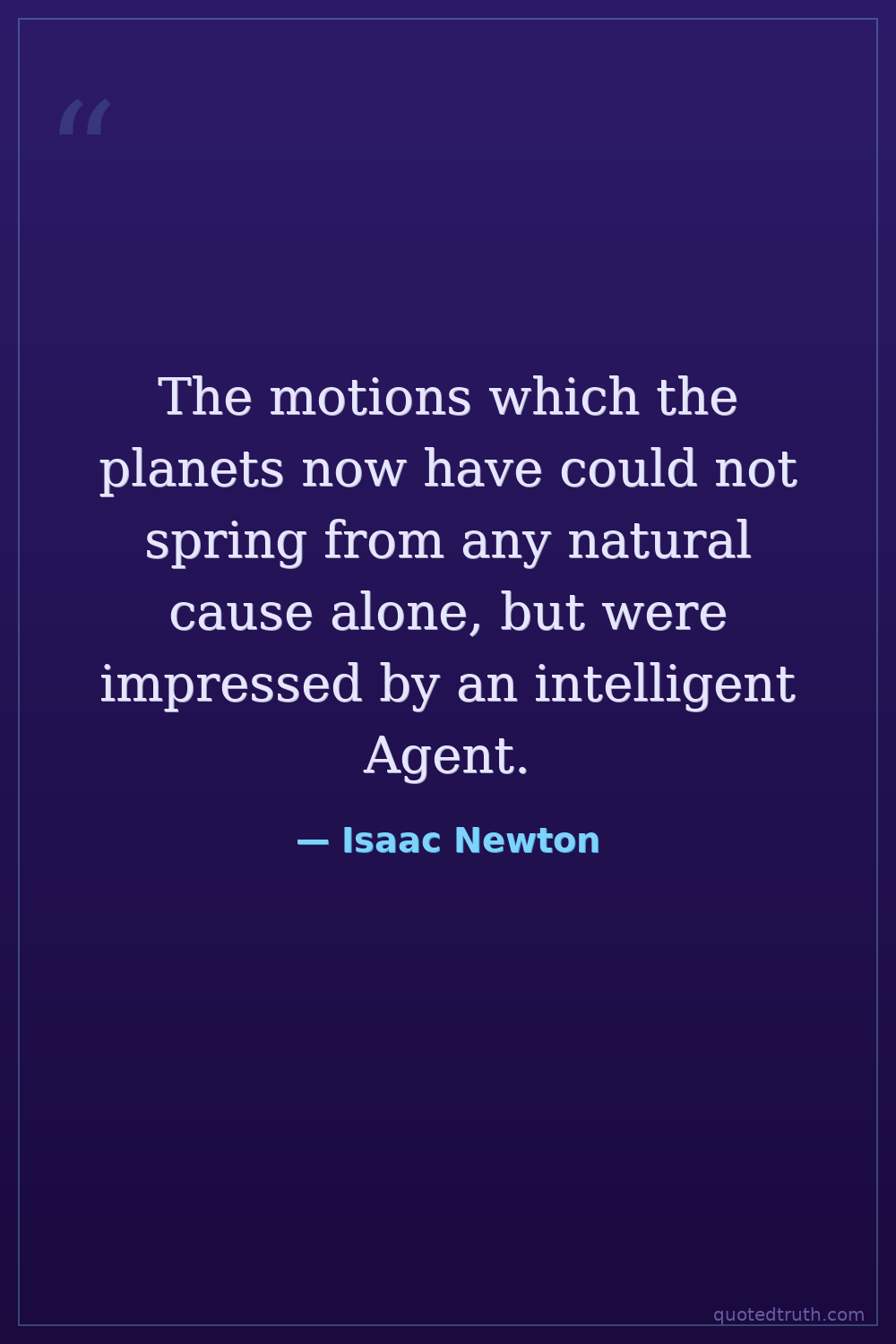
The motions which the planets now have could not spring from any natural cause alone, but were impressed by an intelligent Agent.
The motions which the planets now have could not spring from any natural cause alone, but were impressed by an intelligent Agent.
Click any product to generate a realistic preview. Up to 3 at a time.
* Initial load can take up to 90 seconds — revising the preview in another color is nearly instant.
"Can it be by accident that all birds beasts and men have their right side and left side alike shaped (except in their bowels) and just two eyes and no more on either side the face & just two ears on e…"
"I was like a boy playing on the seashore."
"The great ocean of truth lay all undiscovered before me."
"It seems probable to me, that God in the beginning formed matter in solid, massy, hard, impenetrable, moveable particles..."
"In the absence of any other proof, the thumb alone would convince me of God's existence."
Found in 1 providers: grok
1 source checked
The quote argues that the precise, stable orbital motions of planets couldn't arise purely from natural physical forces — something intelligent must have arranged them. Even if physics explains how planets continue moving, it can't explain why they were placed with exactly the right speeds and angles to maintain stable orbits. The initial conditions required a designing mind. Natural law governs ongoing motion, but the starting configuration demanded intentional, intelligent creation.
Newton discovered universal gravitation and mathematically described planetary orbits — yet believed this very precision pointed to God. He spent more time on theology than physics, writing extensively on Scripture and biblical prophecy. He saw natural philosophy as uncovering God's design, not replacing it. This quote reflects his genuine conviction: gravity explains orbital maintenance, but only God could have set the initial velocities with such exquisite, life-permitting precision — a view he expressed directly in his Opticks and correspondence with Richard Bentley.
The 17th-century Scientific Revolution transformed European thought, but natural philosophy and theology remained deeply intertwined. Descartes and Leibniz debated whether a mechanical universe made God superfluous. Newton wrote during intense controversy over whether his own gravitational system rendered divine intervention unnecessary — a concern among clergy, philosophers, and Newton himself. His statement was a direct theological defense: the cosmic machine was real, but God was the engineer who wound it up and set it running with perfect initial conditions.
AI-generated insights based on extensive research and information for context. Factual errors? Email [email protected].
Your cart is empty