Leonardo da Vinci — "No human investigation can be called true science if it doesn't pass through mat…"
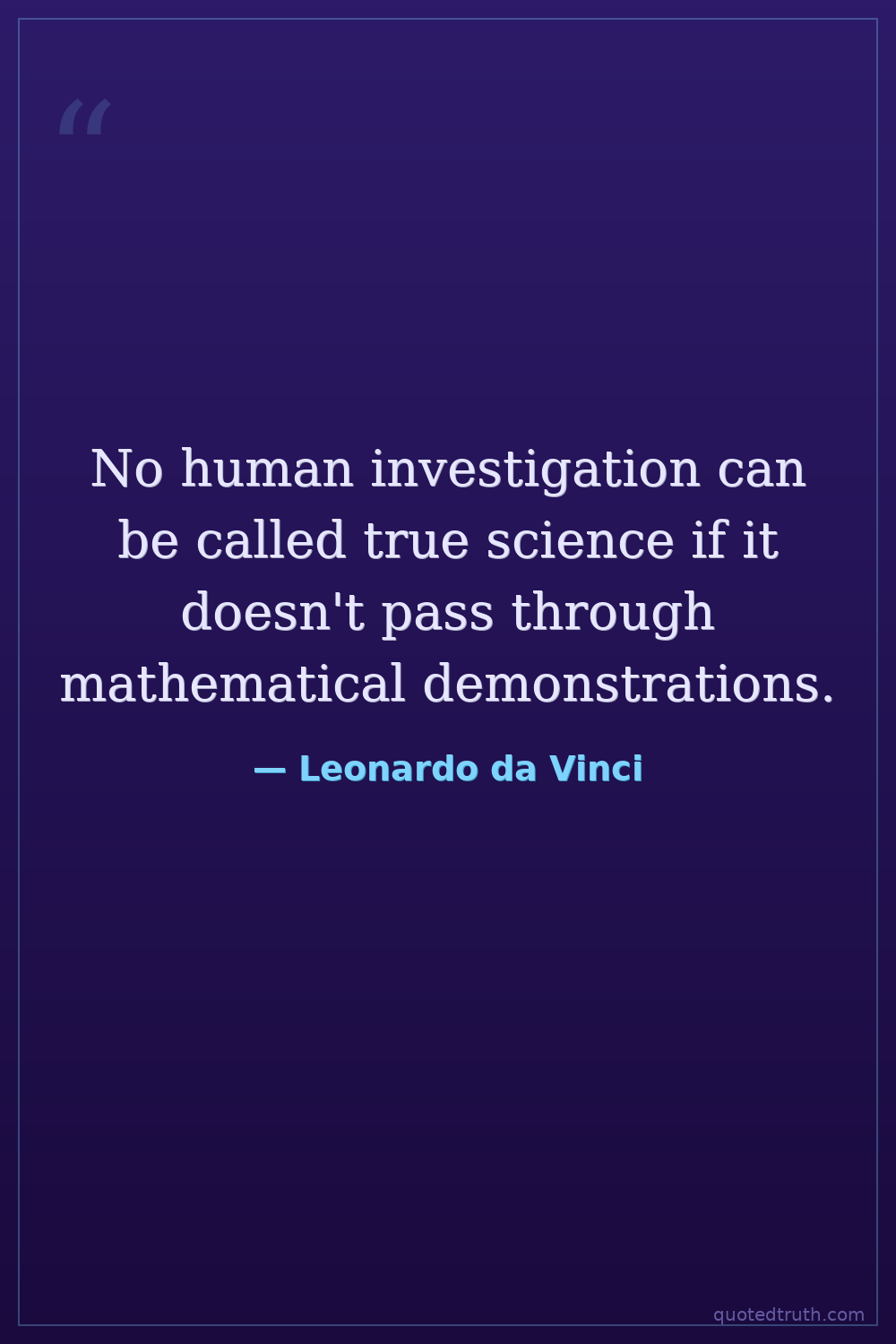
No human investigation can be called true science if it doesn't pass through mathematical demonstrations.
No human investigation can be called true science if it doesn't pass through mathematical demonstrations.
Click any product to generate a realistic preview. Up to 3 at a time.
* Initial load can take up to 90 seconds — revising the preview in another color is nearly instant.
"The memory of all that is past is as nothing in comparison with the knowledge of what is to come."
"Thou, O God, dost sell us all good things at the price of labour."
"Intellectual passion drives out sensuality."
"There are three classes of people: those who see, those who see when they are shown, those who do not see."
"Men will seem like wooden puppets, moving without reason."
Found in 1 providers: grok
1 source checked
Knowledge without mathematical proof isn't science — it's guesswork. This quote insists that genuine understanding requires moving beyond observation and intuition into quantifiable, demonstrable logic. Whether studying nature, building machines, or mapping the human body, conclusions only become reliable when expressed and verified through numbers and formal proof. It's a direct argument for rigor over assertion, for evidence that can be tested and repeated rather than merely claimed.
Leonardo filled thousands of notebook pages with geometric diagrams, hydraulic calculations, and anatomical measurements — math was inseparable from his art and invention. His mastery of linear perspective required projective geometry. He calculated load distributions for bridge designs and studied the mathematics of bird flight. A self-taught polymath lacking formal university training, he compensated by demanding mathematical proof for every claim, elevating observable, quantifiable truth above inherited scholastic authority.
Leonardo lived during the Renaissance (1452–1519), when European thinkers were reclaiming ancient Greek and Arabic mathematics while challenging medieval Church-sanctioned knowledge. The printing press had just arrived, spreading ideas faster than ever. Copernicus was rethinking cosmology. Scholars were moving from theology-based explanations toward empirical observation. Yet most natural philosophy remained qualitative and speculative. Leonardo's insistence on mathematical proof was a radical, forward-looking stance that anticipated the Scientific Revolution by a century.
AI-generated insights based on extensive research and information for context. Factual errors? Email [email protected].
Your cart is empty