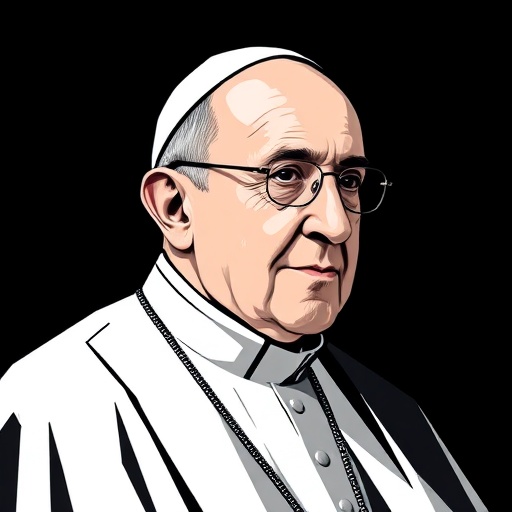
Pope Francis — "No one can be condemned forever, because that is not the logic of the Gospel."
No one can be condemned forever, because that is not the logic of the Gospel.
No one can be condemned forever, because that is not the logic of the Gospel.
Click any product to generate a realistic preview. Up to 3 at a time.
* Initial load can take up to 90 seconds — revising the preview in another color is nearly instant.
"Don’t forget the smile. The smile is important."
"I have not lost my peace. I would not know how to live without peace."
"A Christian who is not a revolutionary is not a Christian."
"The human family has not received a gift of power, but rather a stewardship, a trust that must be used with responsibility."
"If someone is gay and he searches for the Lord and has good will, who am I to judge?"
First Latin American and Jesuit pope (2013-), who has steered the Catholic Church toward pastoral inclusion on LGBTQ pastoral care, divorced Catholics, and climate. Closely associated with Pope John XXIII (the Vatican II reformer pope) and Cardinal Walter Kasper (his theological ally on pastoral reform). For an intellectual contrast, see Cardinal Raymond Burke, American traditionalist cardinal, former head of the Vatican Apostolic Signatura — Burke is the public face of Catholic traditionalism that views Francis's pastoral approach as doctrinally dangerous — he has formally challenged Amoris Laetitia and other Francis reforms.
Found in 1 providers: deepseek
1 source checked
The quote asserts that permanent condemnation of any person contradicts the core logic of Christianity. The Gospel is fundamentally about mercy, redemption, and ongoing possibility for transformation. Writing someone off as beyond saving — spiritually, morally, or socially — conflicts with a message centered on grace and forgiveness. No matter what a person has done, the door to reconciliation and mercy must remain open. Finality belongs to God, not human judgment.
Pope Francis built his papacy on mercy as the Church's defining identity. In 'Amoris Laetitia,' he reopened pastoral care for divorced and remarried Catholics long excluded from sacraments. As a Jesuit trained in discernment and accompaniment, he consistently prioritized compassion over condemnation. His outreach to prisoners, migrants, and those the institutional Church previously sidelined reflects his core conviction that the Gospel's logic demands ongoing mercy — never permanent exclusion from grace.
Pope Francis leads during an era of intense polarization, cancel culture, and debates about irredeemability — from mass incarceration and criminal justice reform to Church discipline over abuse scandals. Questions raged about permanently excluding divorced, remarried, or LGBTQ+ Catholics from sacraments. Politically, dehumanizing rhetoric labeled entire groups as beyond redemption. His statement directly challenged both secular and religious trends toward treating condemnation as final, asserting mercy as structurally essential to Christian logic.
AI-generated insights based on extensive research and information for context. Factual errors? Email [email protected].
Your cart is empty