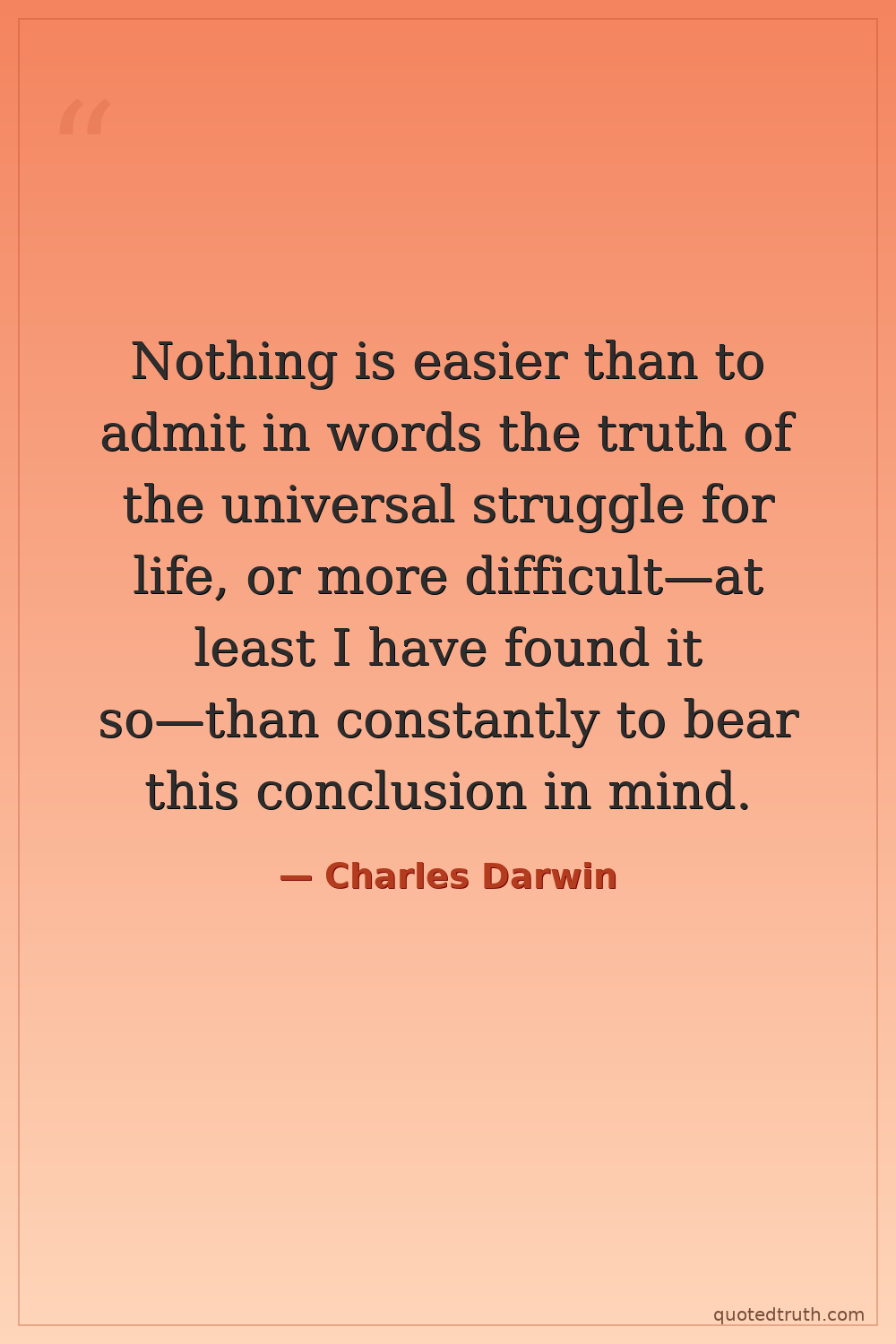
Charles Darwin — "Nothing is easier than to admit in words the truth of the universal struggle for…"

Nothing is easier than to admit in words the truth of the universal struggle for life, or more difficult—at least I have found it so—than constantly to bear this conclusion in mind.
Charles Darwin — Charles Darwin Modern · Theory of evolution

Get This Quote & Author's Image Illustrated On:

Click any product to generate a realistic preview. Up to 3 at a time.
* Initial load can take up to 90 seconds — revising the preview in another color is nearly instant.

Kitchen

Apparel

Other

About Charles Darwin (1809-1882)

British naturalist whose On the Origin of Species (1859) established evolution by natural selection — the unifying theory of modern biology. Closely associated with Thomas Henry Huxley (his 'bulldog' public defender) and Alfred Russel Wallace (independent co-discoverer of natural selection). For an intellectual contrast, see William Paley, Anglican theologian and Natural Theology author (1743-1805) — Origin of Species is structurally a 400-page reply to Paley — Darwin admired Paley's watchmaker-argument as an undergraduate at Cambridge and then spent 20 years building the empirical machinery to displace him. The cleanest 'design argument vs natural selection' founding rebuttal in science.

The standard scholarly entry points to Charles Darwin's work: Janet Browne (Harvard, history of science) — Charles Darwin: Voyaging (1995) and The Power of Place (2002); Adrian Desmond (UCL, biographer) — Darwin: The Life of a Tormented Evolutionist (1991, with James Moore). These are the works graduate seminars cite when teaching Charles Darwin.

Details

From 'On the Origin of Species', on the difficulty of abstract thought.

Date: 1859

Self-Deprecating

Verification

Unverifiable

Found in 1 providers: grok

1 source checked

Understanding this quote

What it means

Acknowledging intellectually that all living things compete for survival is simple enough to say, but genuinely internalizing that truth—letting it reshape how you see every organism, every relationship, every death in nature—is profoundly hard. Darwin admits that even he struggled to keep this uncomfortable reality consistently in focus rather than slipping back into comfortable, conventional ways of thinking.

Relevance to Charles Darwin

Darwin spent over twenty years after the Galápagos voyage before publishing On the Origin of Species, partly wrestling with exactly this psychological difficulty. As a gentleman naturalist raised in Anglican England, accepting that nature operates through relentless, impersonal competition—not divine benevolence—challenged his own upbringing. This confession of personal struggle reveals his intellectual honesty and the emotional weight his own theory carried.

The era

Victorian England in the 1850s–60s operated under a largely providential worldview: nature was God's harmonious design, suffering had moral purpose, and human civilization stood apart from brute animal struggle. Darwin's theory demolished that comfort. Admitting a universal struggle for existence meant accepting a cosmos indifferent to suffering, which collided directly with Victorian religious sensibility, social optimism, and the era's confidence in divine moral order.

AI-generated insights based on extensive research and information for context. Factual errors? Email [email protected].
Your Cart

Your cart is empty