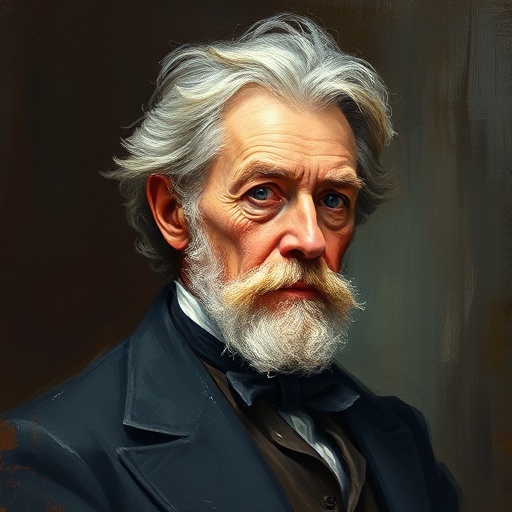
Michael Faraday — "Nothing is too wonderful to be true if it be consistent with the laws of nature."
Nothing is too wonderful to be true if it be consistent with the laws of nature.
Nothing is too wonderful to be true if it be consistent with the laws of nature.
Click any product to generate a realistic preview. Up to 3 at a time.
* Initial load can take up to 90 seconds — revising the preview in another color is nearly instant.
"The greatest enemy of knowledge is not ignorance, it is the illusion of knowledge."
"The beauty of nature is a constant source of inspiration for me."
"I am no poet, but if you think for yourselves, as I proceed, the facts will form a poem in your minds."
"The lecturer should give the audience full reason to believe that all his powers have been exerted for their pleasure and instruction."
"The secret of my success is due to my happy facility of being able to draw correct conclusions from imperfect data."
Found in 1 providers: deepseek
1 source checked
Faraday is saying that no discovery, however astonishing, should be dismissed as impossible simply because it defies expectation. If something fits within the consistent rules that govern the physical world, it deserves serious investigation. Wonder is not a reason for skepticism; contradiction with natural law is. The quote invites curiosity and humility, urging us to test surprising claims against reality rather than reject them on the basis of how strange or marvelous they sound.
Faraday lived this principle. A self-taught bookbinder's apprentice, he rose to discover electromagnetic induction, diamagnetism, and the laws of electrolysis by trusting experiments over prevailing dogma. A devout Sandemanian Christian, he saw nature's laws as divinely consistent, making wonder and rigor inseparable. He rejected mathematical speculation he could not picture physically, insisting that phenomena, however extraordinary, had to be demonstrable in the laboratory before he accepted them as real.
Faraday worked in early-to-mid 19th century Britain, an age when industrial invention, steam power, and electrical experiments were rapidly reshaping daily life. Scientific authority was shifting from gentlemen philosophers to working experimentalists at institutions like the Royal Institution. Public lectures drew huge crowds, and electricity seemed almost magical. Yet superstition and fraud still mingled with genuine discovery, so Faraday's insistence on consistency with natural law was a timely standard for separating true marvels from hoaxes.
AI-generated insights based on extensive research and information for context. Factual errors? Email [email protected].
Your cart is empty