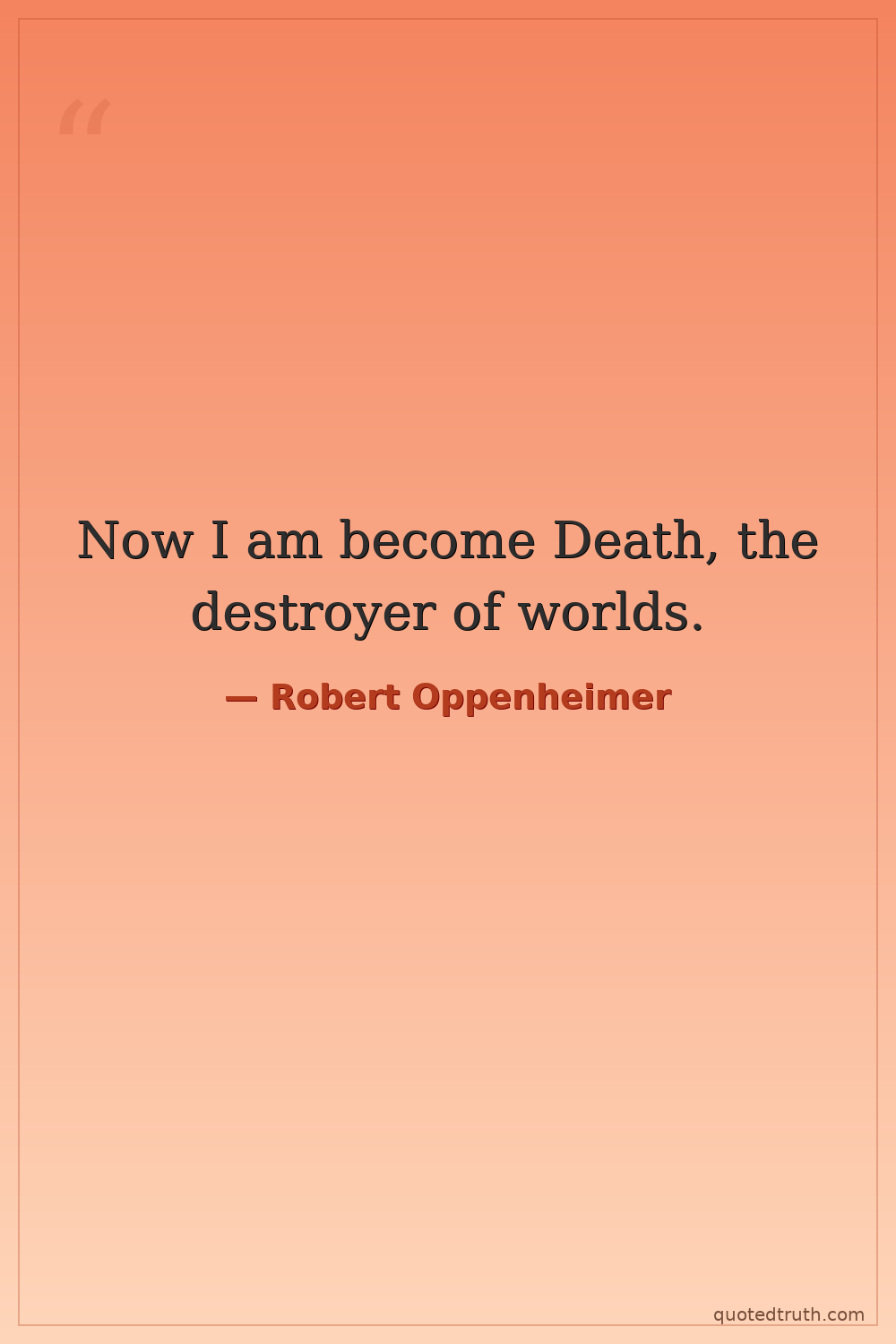
Robert Oppenheimer — "Now I am become Death, the destroyer of worlds."
Now I am become Death, the destroyer of worlds.
Now I am become Death, the destroyer of worlds.
Click any product to generate a realistic preview. Up to 3 at a time.
* Initial load can take up to 90 seconds — revising the preview in another color is nearly instant.
"I need physics more than friends."
"There are some people who can live without wild places, and some who cannot."
"There are no experts on the future."
"It is not possible to be a scientist unless you believe that it is good to learn. It is not possible to be a scientist unless you believe that it is of the highest value to learn. It is not possible t…"
"The atomic bomb is a culmination of a hundred years of physics."
American theoretical physicist who directed the Manhattan Project's Los Alamos Laboratory and oversaw the atomic bombs; lost his security clearance in 1954. Closely associated with Niels Bohr (Manhattan Project consultant and atomic-policy advisor) and Hans Bethe (Los Alamos theoretical-division chief). For an intellectual contrast, see Edward Teller, Hungarian-American physicist and 'father of the H-bomb' — Teller pushed the H-bomb against Oppenheimer's objections and testified against him at his 1954 security hearing — the precise moment that ended Oppenheimer's career. The canonical 'physicist-of-conscience vs physicist-of-state' pairing in nuclear-age ethics; Christopher Nolan's Oppenheimer (2023) dramatized this rivalry for a mass audience.
Quoting the Bhagavad-Gita after witnessing the first nuclear explosion (Trinity test)
Date: 1945
Self-DeprecatingFound in 3 providers: deepseek,gemini,grok
3 sources checked
A person recognizes they have unleashed something catastrophically destructive and irreversible. The speaker claims kinship with death itself—not metaphorically but literally—acknowledging they have become an agent of mass annihilation. It captures the weight of moral responsibility when human capability surpasses human wisdom, and the horror of realizing you cannot undo what you have set in motion.
Oppenheimer quoted the Bhagavad Gita at the Trinity test, July 16, 1945, watching the first atomic bomb detonate. A polymath who read Sanskrit in the original, he understood precisely what he was citing. He later became a vocal opponent of the hydrogen bomb and lost his security clearance in 1954—a man haunted by his own creation, spending his remaining years warning against nuclear proliferation.
World War II's Pacific theater showed no signs of ending without catastrophic Allied casualties. The Manhattan Project united 130,000 workers across secret sites. Hiroshima and Nagasaki followed Trinity within weeks, killing over 200,000 people. The postwar nuclear arms race between the US and USSR defined the entire Cold War era, producing a doctrine of mutually assured destruction that held the world in existential tension for fifty years.
AI-generated insights based on extensive research and information for context. Factual errors? Email [email protected].
Your cart is empty